in Barcelona
 3 to 5 Nov 2026

The Communauté d’agglomération Chauny-Tergnier-La Fère, the authority responsible for household waste in 48 communes of the Aisne department in northern France, will invert the collection frequency of its black and yellow bins from Monday 1 February 2027, launch a resident app called Mes déchets CTLF and fit its collection trucks with geolocation and AI-based cameras, according to a presentation to elected officials reported by Paris-Normandie on 6 November 2026. The changes run under a six-year collection contract with SEPUR whose winning offer and maximum framework value is €20.33 million, according to the award notice on BOAMP, and which began on 1 January 2026.
Black Bins Move To Fortnightly Collection, Yellow Bins To Weekly
The first copies of the guide “Le grand guide” were distributed in Tergnier on 2 November 2026, and the new organisation was presented to the elected officials in charge of waste the same week. For households in individual housing, the black bins for residual waste that are emptied every week will be emptied every fifteen days, while the yellow bins for empty packaging that are emptied every fifteen days will be emptied every week.
Nicolas Thibeuf, the vice-president in charge of household waste, told Paris-Normandie that the inversion follows a survey carried out under the local household waste prevention programme. Residents reported at the end of 2025 that the yellow bin fills much faster since the sorting instructions changed, and Thierry Boutilly, the director general of technical services, said the bins overflow, which led the agglomeration to adapt the service. The collection day will change as a consequence.
This project is heading to tender
New smart waste tenders worldwide, flagged daily with an AI summary.
The 2021 rules in the agglomeration’s first waste bulletin set the maximum amount collected at 660 litres per week for the black bin and 1,320 litres every fifteen days for the yellow bin, so the new rhythm reverses the frequency that those limits were built around.
A Resident App Replaces Printed Calendars As The Main Channel
The Mes déchets CTLF app gives each resident a personalised collection calendar configured to the address, with reminder notifications sent the evening before each collection. It includes a sorting guide showing which bin each item belongs in and lets residents report problems such as fly-tipping or a broken bin, and aggregate data will be made available at a later stage.
Cameras On The Rear Of Collection Trucks
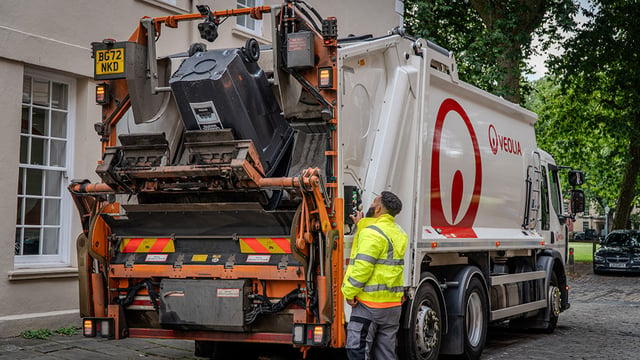
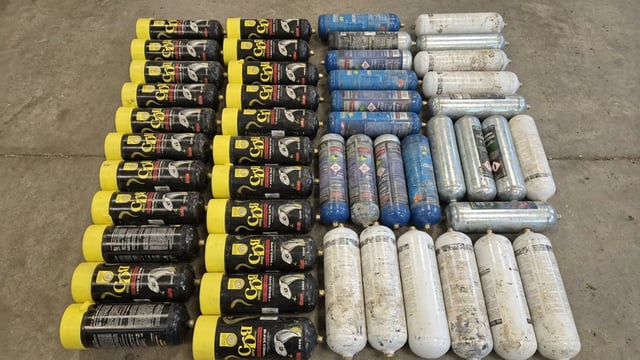
The trucks operated by the contractor SEPUR will be geolocated so that the agglomeration can follow collection rounds, and vision cameras using artificial intelligence will be installed at the rear of each vehicle. The cameras are meant to identify items such as nitrous oxide canisters or batteries so that the crew can set the flow aside before it reaches the sorting centre, and Boutilly said that a sorting centre burns down completely each year. The system is also intended to detect sorting errors, working with chips fitted to the bins, and Thibeuf said that only about 30% of the content of the black bins should be there.
The agglomeration’s own earlier figures give a baseline for the error rate. The 2021 bulletin reported a sorting error rate on recyclables of 9.37% in 2019 and 6.94% in 2020, and glass collection of 34.6 kilograms per inhabitant in 2019 and 37.6 kilograms in 2020.
The Contract Behind The Changes
The contract was awarded by competitive dialogue as a performance-based agreement for the collection and prevention of household and similar waste, and covers residual waste, recyclable multi-materials, glass and green waste, together with the transport of waste from the recycling centres of Beautor, Chauny and Tergnier. The estimated value of the procedure was €14 million excluding VAT, the estimated value of the lot was €16.8 million, and subcontracting is valued at €6.78 million. Two offers were received, and the contract was concluded on 8 December 2025 with the award notice sent on 18 December 2025.
A prior information notice published on 28 January 2025 had set out the scope the agglomeration wanted in a single contract replacing the collection and transport contracts that expired on 31 December 2025: household and recyclable waste, glass, green waste and bio-waste, transport from recycling centres, reading of data from bin sensors, bin maintenance and delivery, performance incentives and operating premises in Tergnier. Operators had until 20 February 2025 to express interest.
How Camera-Equipped Collection Has Performed Elsewhere
Veolia has been fitting optical recognition cameras from the Paris start-up Lixo to commercial collection vehicles, with a target of 40 equipped vehicles serving more than 12,000 professional customers across France by October 2025 and four trucks serving roughly 2,000 businesses in Bordeaux as of February 2026. In that service the cameras photograph each customer’s container contents as they are tipped, and machine-learning models sort them into more than 30 material families that are attributed to the customer in a report.
Those deployments cover businesses rather than households and are described as largely pilots, and neither Veolia nor Lixo has published audited accuracy figures for the recognition, so the Chauny-Tergnier-La Fère rollout will produce one of the few household-level data sets from a contracted fleet.
SEPUR published a statement on 16 December 2025 describing a technology partnership with Ficha, a company specialising in artificial intelligence solutions, for AI applied to collection. Ficha, which sells the Camia onboard camera system that photographs waste as bins are emptied, reports on its website that sorting errors on packaging collected in the SIETREM area fell from 27.3% to 17.8%, a figure supplied by the vendor.
The 6.94% recyclables error rate recorded in 2020 is the nearest published baseline against which the camera data from the 1 February 2027 start can be compared.