in Barcelona
 3 to 5 Nov 2026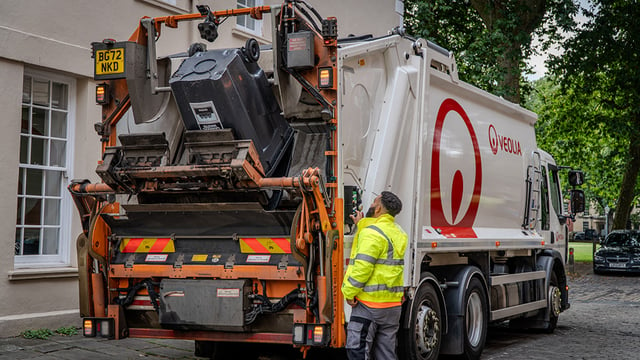
Veolia, the French environmental services group, is extending its camera-equipped collection service for commercial and industrial waste to the Loiret department.
The service, built with Paris start-up Lixo, fits optical recognition cameras to refuse collection vehicles so that the contents of each business customer’s container are photographed as they are tipped, classified by machine-learning models into more than 30 material families, and attributed to the customer for a sorting report.
A National Programme Arriving Region by Region
Veolia first described the offer in an October 2025 press release, setting a target of 40 equipped vehicles across France serving more than 12,000 professional customers, a figure the company has not broken down by region.
The first units went into service in Auvergne-Rhône-Alpes, with two vehicles at Meyzieu near Lyon, one at Voreppe in Isère and one at Valence in the Drôme, according to Lyon Entreprises, while three more were reported in operation around Toulouse.
Kurrantly has followed the rollout as it moved west, most recently when four camera-equipped trucks began serving roughly 2,000 businesses in the Bordeaux area in February 2026, and the Loiret announcement landed one day after Veolia presented the same vehicles at its Rennes site on 24 September 2026, as reported by 7 Jours.
“Optimise sorting to promote recycling,” said Marc-Olivier Houel, director general of Veolia Recyclage & Valorisation France, describing the aim of the service in the company’s October 2025 press release, a phrase La République du Centre repeated in its Loiret coverage.
What the Chaingy Operation Brings to the Rollout
Veolia’s Loiret waste business trades as Société Orléanaise de Combustibles et de Collecte d’Ordures Industrielles et Ménagères (SOCCOIM), a subsidiary founded in 1968 that, according to company registry data compiled by Pappers, employed 371 people in 2025 and reported revenue of €68.8 million, down from €76.7 million in 2022.
Its site in the Pierrelets business zone at Chaingy has operated a sorting centre since December 1996, and the national SINOE waste facility database records that a dedicated sorting line for commercial and industrial waste, known in France as DAE, entered service there at the start of 2020.
That combination matters for a camera programme, because the value of knowing what is in a customer’s container depends on having a downstream line able to recover the separated fractions rather than sending mixed loads to landfill or incineration.
Veolia also holds household waste work in the same catchment, having been selected by Orléans Métropole and six other local authorities to manage waste for a combined population of 650,000, although the camera service described in the Loiret is aimed at business customers rather than municipal rounds.
How the Recognition System Works
In the Lyon deployment, operations staff described a sequence in which the truck-mounted camera captures images of the waste as it drops into the hopper, the images are uploaded to software, and the software assigns each collection a contamination score, according to Lyon Demain.
Veolia says the resulting customer reports are used to recommend changes in container type, signage, staff training and collection frequency, and to document compliance, all of which are the company’s own descriptions of intended use rather than independently measured outcomes.
Lixo, co-founded by chief executive Marjorie Darcet and chief technology officer Olivier Large, raised €3.5 million in a January 2022 seed round led by Demeter Partners and Raise, and at that time already counted Veolia, Brangeon and Citeo among its customers, according to Construction BTP.
Veolia has stated that the image classification layer was developed in-house on top of Lixo’s optical hardware, so buyers evaluating the service are assessing a vendor pairing rather than a single supplier’s product, and neither company has published recognition accuracy figures for commercial waste that have been independently audited.
The Regulatory Pressure Behind Business Sorting
The commercial case rests on Decree No. 2021-1199 of 16 September 2021, which requires operators of landfill and incineration sites to inspect incoming non-hazardous waste, to refuse loads that do not meet sorting requirements, and to obtain annual attestations from non-household producers describing the separate collection arrangements they have in place.
Those obligations sit on top of France’s 2020 anti-waste and circular economy law, known as AGEC, and the older requirement for businesses to separate paper, metal, plastic, glass, wood, textiles and mineral fractions at source, so a waste producer that cannot show what it throws away carries both a compliance risk and a cost risk.
Veolia’s argument is that a photograph taken at every lift produces an evidence trail that a once-a-year manual characterisation cannot, and that the same evidence can be turned back into advice for the customer.
In Lyon, Veolia staff told Lyon Demain that the first phase was educational and that financial consequences for poorly sorted containers would follow in 2026, since contamination triggers surcharges for re-sorting and for treatment of residual waste.
Scale Against the Size of the Problem
Set against a group that treated 64 million tonnes of waste worldwide in 2025, according to a Veolia release carried by Business Wire, a fleet of 40 camera trucks remains a small instrument, and the Loiret article does not state how many vehicles or customers the Chaingy agency will equip.
Competitors are testing similar approaches, with Grenoble-based Ficha equipping a collection vehicle for the Mauges Communauté intercommunal authority in Maine-et-Loire from February 2026, although that project, like most of Veolia’s regional deployments, is still described as a pilot rather than a contractual service standard.