in Barcelona
 3 to 5 Nov 2026
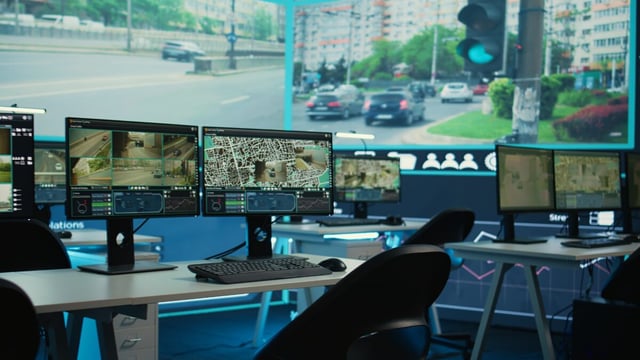
The Comune di Monza, the Lombardy municipality north-east of Milan, put a new video management platform with real-time video analytics into operation on 26 October 2026, covering a network of 283 cameras and 442 viewing points that has absorbed more than €460,000 of investment over the past three years, according to a report published by ComoZero on 28 October 2026.
The platform runs from the control room of the Polizia Locale command on via Marsala, where eight operators work each day in two-person units across four shifts, and it sends automatic alerts to operators’ devices when its algorithms detect a person on the ground, a possible assault, a fire or a vehicle in a prohibited area.
A Network Of 283 Cameras Behind 442 Viewing Points
The difference between the two headline figures comes from the hardware, because the city’s devices range from single-lens and dual-lens units to four-lens and composite systems, so one camera housing can supply several viewing points across streets, squares and parks. Fifteen of the 283 cameras were installed in the last ten months, and the network is active 24 hours a day.
Part of the expansion is tied to urban planning agreements, under which developers fund installations as a condition of building works. Cameras delivered under the Elesa and Iperal interventions at the Rondò dei Pini are already operating, and further additions of up to 40 cameras are scheduled around the San Rocco schools, the Cederna library, piazza Giovanni XXIII, viale Sicilia and via Pompei.
Other works in the programme include the renewal of the video surveillance system at the city cemetery, an extension to the offices of the Centro Aiuto Donne Maltrattate (CADoM) on via Donatello, two new cameras in the gardens of via Campini and five in piazza Cambiaghi, where the supporting infrastructure has already been prepared.
Analytics Alerts Change The Operator’s Task From Watching To Responding
The new platform processes images in real time and flags situations that may require intervention, which moves the operator’s work from continuous screen watching to responding to prompts. The event categories named by the municipality are people lying on the ground, possible aggressions, fires and vehicles in restricted areas, and each alert arrives directly on the operator’s device.
The staffing figures show why that design matters. With eight operators per day divided into four shifts, two people cover each shift, which works out to roughly 142 cameras and 221 viewing points per operator on duty, based on a Kurrant calculation from the published numbers. Manual review of that volume is not practical, so the quality of the detection rules, and the share of alerts that prove actionable, will set the real workload of the control room.
Field staff are supported by 40 bodycams worn during outdoor interventions and traffic support services, which the municipality says contribute to the safety of personnel and to the management of operational situations.
Thirty Electronic Gates And River Sensors Extend The System Beyond Cameras
The video network is paired with 30 electronic gates installed at as many access points to Monza. They monitor traffic flows, a function the municipality links to large events and demonstrations, and they run automated licence plate checks that support targeted controls by the police.
The ComoZero report also lists camera traps and sensors that monitor the water level of the Lambro river among the technologies now operating, which places environmental monitoring inside the same programme as public safety. The municipality describes the platform as part of a smart city path in which several city departments contribute to monitoring the territory, controlling access to the city and protecting sensitive places.
What The Investment Figure Covers
The more than €460,000 reported was spent over three years on strengthening video surveillance and connecting the installations into a single network. Spread across the 283 cameras now active, and treating the full amount as camera-related, the figure equals about €1,625 per camera, a Kurrant calculation that should be read as an upper bound for cost per unit because the sum also covers networking work.
The platform adds a software layer to infrastructure that was largely in place, which is a pattern seen in municipal deployments where analytics are applied to existing cameras rather than to a new build. The number of cameras that carry the analytics rules, as opposed to those that only record, is the figure that will determine how much of the 442 viewing points the alerts actually cover.
The next measurable steps are the installation of up to 40 additional cameras, the cemetery renewal and the CADoM extension, each of which adds viewing points to a control room that stays at two operators per shift; the ratio of alerts to staff after those additions will be the benchmark against which the platform’s response-time objective can be judged.