in Barcelona
 3 to 5 Nov 2026
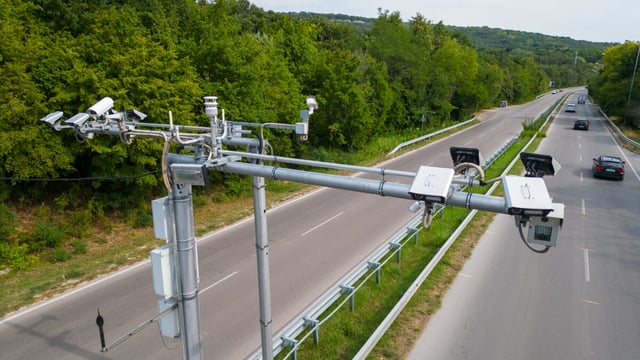
Via Lietuva, the state company that manages Lithuania’s national road network, has contracted Jenoptik Baltic, the Vilnius-based unit of Jenoptik Smart Mobility Solutions, to supply and install 216 additional automatic number plate recognition cameras at about 125 sites on tolled state roads within twelve months, according to a press release distributed on 29 October 2026. Lithuanian outlet Reidas reported that the equipment is worth €2 million including VAT, while Jenoptik describes the order only as worth a low single-digit number of millions of euros, and the cameras are intended to support enforcement when the Via Toll distance-based charging system starts on 1 January 2027.
The new units will join about 450 monitoring points already operating on the paid road network, which Reidas says will grow to about 670 once the installation is complete, so the order adds roughly 48 percent to the existing camera count.
Via Toll Moves Commercial Traffic To Per-Kilometre Charging
According to Via Lietuva, Via Toll applies to vehicle categories M2, M3, N1, N2 and N3, while private passenger cars in category M1 remain outside the scheme, and the charge is calculated on the distance actually driven instead of the time-based e-vignette that heavy goods and commercial vehicles pay today. The rates were approved by the Lithuanian Transport Safety Administration and published on 30 June 2026, and trans.info reported preliminary figures for vehicles above 12 tonnes that range from €0.111 per kilometre for a EURO VI truck with up to three axles to €0.266 per kilometre for a EURO 0 truck with five or more axles.
Drivers, vehicle owners and the representatives of companies that own the vehicles face fines of €700 to €1,000 for unpaid tolls, which is the penalty the camera network is meant to trigger by detecting plates that have no matching payment.
The Camera Order Is Separate From The Core Tolling Contract
The core system is being delivered by Kapsch TrafficCom, the Austrian group that won an international open tender and signed a €16.2 million contract including VAT on 6 February 2026, according to LRT. That agreement covers a heavy-vehicle tolling system leased for five years, and the Jenoptik Baltic contract is a separate equipment award that adds roadside capacity to the enforcement layer.
Martynas Gedaminskas, chief executive of Via Lietuva, framed the purchase as part of the preparations for the January start in the same press release: “A smooth transition requires a range of tasks of varying complexity, and one of the planned measures is to strengthen enforcement.”
Dividing the Reidas figure by the number of cameras gives about €9,259 per unit including VAT and installation, and dividing the 216 cameras by the 125 sites gives an average of 1.73 cameras per location, so a large share of locations will carry two units, which allows one site to record plates in both directions of travel while each GardoVia unit is specified to cover up to two lanes.
GardoVia Hardware And The FIMA Acquisition Behind The Award
The cameras are from the GardoVia family, which Jenoptik specifies with a 1.6 megapixel colour CMOS sensor at 1,456 by 1,088 pixels, eight infrared LEDs at 850 nanometres, a measuring range of 0 to 300 kilometres per hour across one or two lanes of 3.75 metres, IP67 housing, an operating range of -30 to +60 degrees Celsius, an onboard Nvidia processor and 32 gigabytes of default storage that can be extended to 256 gigabytes. These figures are manufacturer specifications, and the company describes the product as a cost-effective, police-grade system for tolling, parking management, access control and civil security, with mounting heights of one to 18 metres.
Jenoptik Baltic was formerly FIMA ITS, the intelligent transportation systems business of the Vilnius-based FIMA group, which Jenoptik acquired with effect from 2 March 2026 and which Kurrantly covered at the time of the deal. According to Jenoptik, the FIMA unit had worked with the group for more than 15 years and had implemented Lithuania’s earlier nationwide e-tolling system based on ANPR technology, so the new order extends a camera estate that the same team already maintains.
Jenoptik’s Position In The Region
Jenoptik is headquartered in Jena, Germany, employs approximately 4,300 people worldwide, is listed in Frankfurt and traded on the MDax and TecDax indices, and reported revenue of €1,046 million in fiscal year 2025. Within the group, Jenoptik Smart Mobility Solutions supplies enforcement cameras, ANPR systems, average-speed measurement platforms and road-user charging infrastructure, and its installed base is described by the company as tens of thousands of systems deployed worldwide over four decades of ANPR development.
At €2 million, the order represents about 0.19 percent of the group’s 2025 revenue, so its weight for Jenoptik lies in the reference value for the Baltic operation, which Gerrit Palm, vice president for the EMEA region at Jenoptik Smart Mobility Solutions, tied to the integration of the former FIMA ITS business, and in the service and maintenance work that a camera estate of about 670 monitoring points will generate over the years that follow.
What Decides Enforcement Quality After 1 January 2027
The twelve-month delivery window for the 125 sites runs through 2027, so a share of the 216 cameras will be commissioned after Via Toll has already started charging, and the number of units in service on launch day, measured against the 450 monitoring points already operating, will set the first enforcement baseline for a network that Via Lietuva plans to take to about 670 points.