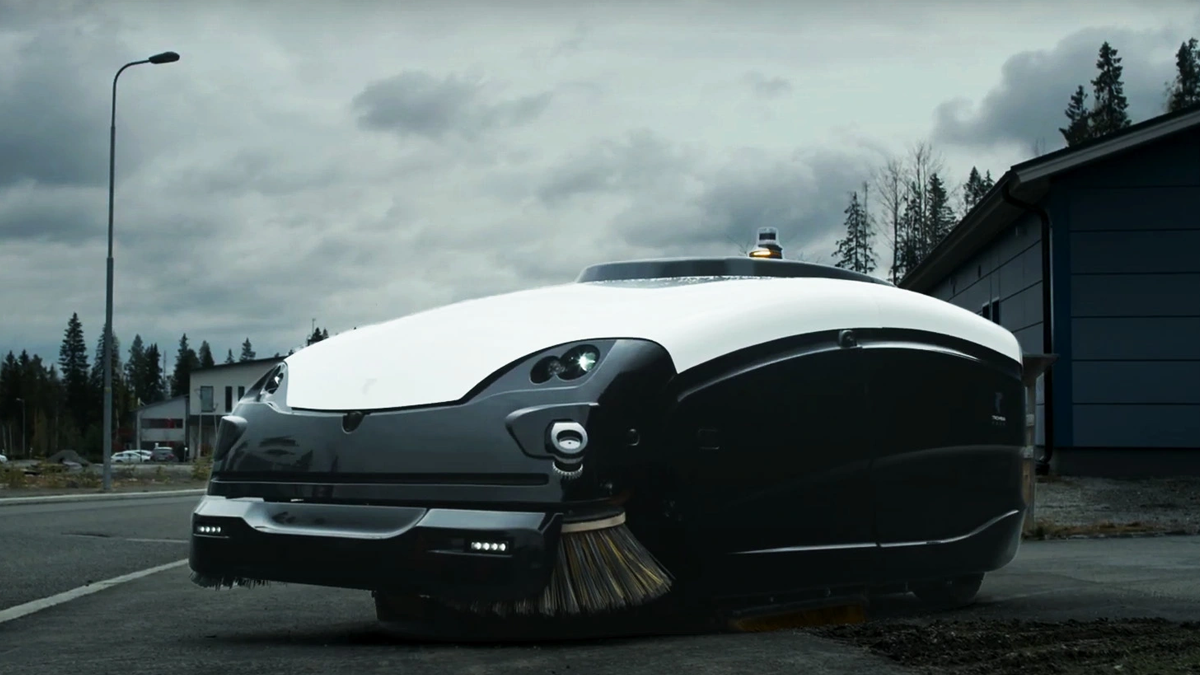
The City of Porvoo, Finland, is putting an autonomous electric street-sweeping robot into service in early August 2026, cleaning the pedestrian and paved areas of Porvoo Market Square and the riverside district, mainly overnight. The machine, supplied by Finnish manufacturer Trombia Technologies, is roughly the size of a small car, tops out at about 4 kilometres per hour, and is procured under an eight-year robotics-as-a-service contract rather than purchased outright. Porvoo, a coastal city of around 52,000 residents east of Helsinki, says the deployment is aimed at improving cleaning quality and air quality in the city centre while cutting emissions from municipal maintenance work.
Why A Mid-Sized Finnish City Chose A Service Model Over Ownership
Under the arrangement, the City of Porvoo does not own the sweeper. Instead, it buys a street-sweeping service that bundles the robot’s introduction, day-to-day operation, remote monitoring, and maintenance into a single contract with Trombia. The eight-year robotics-as-a-service term reflects a pricing approach Trombia has used since launching its autonomous line in 2020, in which customers pay for cleaning outcomes rather than capital equipment. Porvoo’s Director of Maintenance, Keijo Lehtikangas, said the city is among the first in Finland to adopt this kind of contract for street cleaning.
What The Robot Actually Does On The Ground
The sweeper operates mainly at night in Porvoo Market Square and along the main pedestrian and street areas by the river, with the operating footprint set to expand gradually as the city gathers user experience. It runs during the snow-free season, roughly 26 weeks a year, and is based at a dedicated charging and emptying station in the courtyard of a property on Piispankatu, behind City Hall. Before entering regular service, the machine spent time driving Porvoo’s streets at night purely to map and learn its routes.
“The aim is to improve the quality of street cleaning in central areas. Regular cleaning helps to make the environment more pleasant and improves air quality. This fully electric machine reduces energy consumption and emissions,” said Keijo Lehtikangas, Director of Maintenance at the City of Porvoo, in Trombia Technologies’ August 2026 press release.
Navigation, Safety Systems, And How The Robot Handles Pedestrians
The environment around Porvoo city centre was pre-mapped by Trombia specialists using satellite localisation combined with 3D point-cloud mapping, allowing the sweeper to locate itself precisely as it moves. Trombia’s fleet service team then trained specific sweeping routes into the machine according to a cleaning plan set by the city. During operation, the robot continuously scans for changes in its surroundings, reroutes around obstacles, and gives way to other road users. It is equipped with 3D lidar and safety radar and is built to the PLd safety classification, a performance level under machinery safety standards for systems that must reliably detect and respond to hazards. If it detects a vehicle, pedestrian, or other obstacle, it stops, and a backup stopping system is layered on top of the primary sensors. A remote monitoring room can redirect the robot to a new route or pull up its onboard camera feed, and it assists the machine specifically when it crosses pedestrian crossings. Porvoo has published public guidance telling residents to treat the sweeper on roadways like a slow-moving works vehicle, and on pavements to pass along the edge or take a different route if there is not enough room to pass side by side.
Trombia Technologies’ Path From Attachment Maker To Autonomous Fleet Operator
Trombia Technologies, based in Kuopio and Espoo, Finland, is a subsidiary of Snowek Oy, a snow-plough and sweeper attachment manufacturer founded in 2011, and the company is now part of the German industrial group FAUN. Its core innovation, a patented sweeping system combining mechanical brushing with airknife dust removal and filterless cyclone dust control, was originally sold as a hydraulic attachment for wheel loaders before Trombia adapted it into a standalone autonomous unit called Trombia Free, launched in September 2020. Trombia has piloted the technology in closed environments before moving to open city streets, including a facility-maintenance trial with ISS Finland at a Helsinki airport parking area. The company has also taken part in MURO, a roughly €4.9 million co-innovation project funded by Business Finland, aimed at developing shared-use service-robot platforms for facilities such as shopping centres, offices, and transport hubs.
How The Deployment Fits Into A Broader Shift In Municipal Sweeping
Trombia markets Trombia Free as covering area roughly ten times faster than conventional high-performance sweepers while using about 15 percent of the energy, according to the company’s own product specifications, figures that have not been independently verified for this article. The Porvoo contract adds Finland to a small but growing list of cities piloting autonomous sweepers as a service rather than a capital purchase, a model that shifts maintenance risk and uptime responsibility onto the vendor. Elsewhere, municipal sanitation authorities in China have been scaling up unmanned sweeping fleets, with Guangzhou targeting 1,000 unmanned cleaning units by 2026 and Hangzhou requiring unmanned equipment in new public sanitation tenders, illustrating the wider international momentum behind autonomous area cleaning even as European rollouts remain smaller and more cautious in scope.