in Barcelona
 3 to 5 Nov 2026

Go Eve, the EV charging company spun out of University College Dublin and Imperial College London, has secured £750,000 from Innovate UK and private investors to fund an 18-month programme developing the next version of DockChain, its patented distributed DC fast-charging system for vehicle fleets, with development and testing led by its engineering team in Wolverhampton, England. The funding, reported by Tech.eu on 21 October 2026, comes through Innovate UK’s Growth Catalyst Investor Partnerships programme, and the company is targeting a production-ready version of the system for its manufacturing partners in 2027.
One Power Module, Many Bays
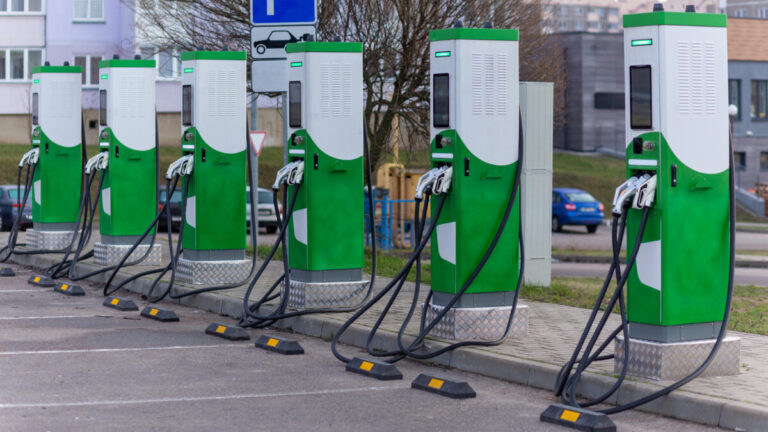
DockChain replaces the conventional depot layout, in which every parking bay is fitted with its own DC charger, with a distributed model in which a single power module feeds a chain of low-cost charging terminals and delivers energy to connected vehicles one after another. Software manages a virtual queue that schedules each plugged-in vehicle in turn, so drivers can leave vehicles connected at the end of a shift without moving them between chargers.
The commercial argument is aimed at the most expensive part of fleet electrification: the number of DC chargers and the size of the grid connection a site needs. Spreading one rapid charger across several bays reduces both, which Go Eve says can lower installation cost and shorten deployment timelines for operators whose vehicles sit parked for long enough that full simultaneous charging is unnecessary.
Building in this space?
Kurrant Ventures backs start-ups digitalising cities and utilities, and opens doors to the operators that buy from them.
- Latitudo 40
- GoodVision
- Meersens
- Cortexia
“The ability to make better use of existing chargers, parking bays and available grid capacity will be increasingly important in managing the EV transition,” said John Goodbody, co-founder and Marketing Director of Go Eve, in the company’s announcement of the funding.
The Engineering Target Is Session Control At The Connector
The new programme will develop custom hardware, firmware and software intended to give DockChain tighter control over starting, stopping and restarting charging sessions without the vehicle being unplugged, according to the company. That requirement comes from field experience with fleet customers: some electric vehicles need a second attempt before a session begins, and others do not resume charging reliably once power flow has been paused, either to respect a site’s grid limit or to give priority to another vehicle.
Those behaviours matter more in a sequential system than in a one-charger-per-bay layout, because DockChain pauses and resumes sessions by design as it moves power around the chain, and a vehicle that refuses to restart can leave the depot under-charged. Go Eve says DockChain units already in the field will be upgradeable to the new design rather than requiring replacement.
The project will also investigate how the architecture could support bidirectional charging and vehicle-to-grid (V2G) services, which would allow parked fleet vehicles to export power during network peaks and earn flexibility revenue. Go Eve is inviting fleet operators to propose trial sites, with a preference for depots where vehicles share limited charging capacity, leave at staggered times with different charging priorities, or stay parked long enough to provide V2G services.
From A £3 Million Seed Round To Grant-Backed Development
The new funding follows a first round of £3 million (€3.5 million) announced in July 2023, when Go Eve raised capital from The Pearl Family Office, Carter Gem, Automotive Ventures Inc., Kero Development Partners and Cur8 Capital, with Imperial College London also listed as a shareholder, according to University College Dublin. At that point the company had completed a pilot installation on the Imperial campus and was preparing its first commercial site installations.
DockChain was invented by Professor Robert Shorten, who serves as Go Eve’s Head of R&D, and the company’s co-founders include chief executive Hugh Sheehy, Dr Pietro Ferraro and Andrew Cullen alongside Goodbody, according to the same UCD announcement.
The Innovate UK Investor Partnerships route pairs grant funding with private investment in the same company, so the £750,000 total combines public and private capital committed to a single development programme with a fixed 18-month timeline and a defined 2027 deliverable.
Shared Charging Competes With Load Management At Fleet Depots
Go Eve’s architecture is one answer to a constraint every depot operator faces: grid connection capacity is often the limiting factor long before parking space or vehicle count. The more common alternative is dynamic load management across conventional chargers, in which each bay keeps its own charger and software caps total site demand; DockChain instead reduces the number of power electronics units installed, which shifts cost from hardware to scheduling software.
The trade-off is throughput. A sequential system suits vehicles with long dwell times, such as delivery vans parked overnight at a depot, and becomes harder to operate when many vehicles must leave at once with high states of charge. The company’s call for trial sites with staggered departures and mixed priorities targets precisely the operating profile where a single shared module can serve several bays without delaying departures.
The V2G strand of the project adds a second revenue variable. Bidirectional power flow through a shared module requires the same reliable session control the programme is building for unidirectional charging, since a vehicle that fails to resume after an export event creates the same operational risk as one that fails to resume after a priority pause.
The milestone that will test the programme is the 2027 production-ready release to manufacturing partners: whether upgraded DockChain units can restart sessions reliably across mixed vehicle makes at the trial depots Go Eve is now recruiting will determine whether fleet operators treat sequential DC charging as a mainstream alternative to per-bay chargers with load management.