in Barcelona
 3 to 5 Nov 2026
The Brussels-based European Commission expects to adopt an EU-wide action plan on the digitalisation of the water sector in the first half of 2027, after Jessika Roswall, Commissioner for Environment, Water Resilience and a Competitive Circular Economy, convened utilities, industry associations, regulators, research bodies and consumer organisations at a roundtable on 9 November 2026 to discuss the draft.
The plan is one of the flagship initiatives of the European Water Resilience Strategy adopted in June 2025, and it targets a sector that supports 1.6 million jobs, is served by around 70,000 drinking water and wastewater operators across 33 countries, and still loses roughly 23.5% of treated water as non-revenue water, according to EurEau’s 2026 statistical report as reported by Euronews.
Consultation Findings Point To Data Plumbing Rather Than Hardware
The Commission’s call for evidence, registered as Ares(2026)5310172 and open from 27 May to 24 June 2026 under the freshwater management unit ENV.C.1, originally indicated adoption in the fourth quarter of 2026, so the current first-half 2027 target represents a slip of at least one quarter.
According to the Commission’s roundtable announcement, contributors identified fragmented water data and data collection systems, a lack of interoperability between those systems, shortages of digital skills and public procurement rules that respondents consider outdated as the main obstacles to adoption.
That diagnosis matters for operators because the practical value of remote metering depends on reconciling customer consumption readings with the volumes injected into each district metered area, a calculation that fails when meter head-ends, network telemetry and billing systems cannot exchange data on a common time base.
“Water resilience is a matter of economic security, industrial resilience and competitiveness,” said Jessika Roswall, Commissioner for Environment, Water Resilience and a Competitive Circular Economy, in the Commission’s 9 November 2026 announcement of the roundtable.
The Water Resilience Strategy actions tracker lists an EU-wide initiative on “smart metering for all” inside the digitalisation action plan, built on two pillars: funding and knowledge-sharing for digital solutions, and national water data portals, while the same strategy sets an aim of improving water efficiency by at least 10% by 2030.
Commission Savings Estimates Frame The Smart Metering Case
The call for evidence states that smart metering can reduce water use by up to 25%, that digital systems can save a further 5% to 8%, and that leak detection can cut consumption by another 7% to 14%, figures the Commission presents as estimates.
The document organises the future plan around four pillars, covering analytics on large data sets, large-scale deployment of Internet of Things devices, routine use of Earth observation and a coherent digital monitoring and governance framework, and states that it is not a legal act.
Water Europe, the Brussels-based technology platform with more than 300 members, used its April 2026 position paper to call for a Digital Single Market for Water Data and Water Operations, with large-scale deployment of smart water metering and digital leakage detection across public networks and private premises, as Smart Water Magazine reported.
The same paper cites national leakage levels in drinking water infrastructure ranging from 8% to 57%, puts the investment the European water sector needs by 2030 at €255 billion, and asks for wider use of the most economically advantageous tender criterion backed by life-cycle cost analysis, arguing that tenders without open standards have locked utilities into proprietary systems.
Operators And Meter Makers Split Over Binding Rollout Targets
EurEau, which represents the roughly 70,000 operators, set out in its August 2026 recommendations that it sees no clear case for new binding digitalisation rules, that early replacement of functioning smart meters should be avoided, and that interoperability through open standards and common data models should take priority over a single European platform.
The AQUA European Association of Smart Meter Manufacturers took the opposite position on targets, asking for ambitious rollout objectives to give manufacturers long-term investment certainty and for harmonised implementation of the Drinking Water Directive to reduce market fragmentation between member states.
Aqua Publica Europea, representing public operators, argued that digital maturity varies widely and that governance and interoperability should be in place before artificial intelligence or Internet of Things tools are scaled, while a joint statement from Xylem, Veolia, Suez and Siemens named upfront investment costs as a major barrier and proposed EU procurement guidelines for digital technologies.
Funding is the constraint behind those positions: Roswall told the Water Innovation Europe 2026 conference in Dublin in October that the sector faces an investment gap of at least €23 billion a year, according to Lovguiden’s summary of the speech, and EurEau has pointed to the 2028 to 2034 Multiannual Financial Framework as the vehicle for dedicated digitalisation funding.
The Drinking Water Directive Sets The Leakage Clock
The binding pressure on utilities comes from Article 4(3) of the recast Drinking Water Directive (EU) 2020/2184, under which member states had to submit leakage assessments for large suppliers to the Commission by 12 January 2026.
The Commission’s May 2026 report on its delegated powers, COM(2026) 235, confirms it is assessing those submissions and must adopt a delegated act by 12 January 2028 setting an EU leakage threshold based on the Infrastructure Leakage Index or another appropriate method, after which member states above the threshold have two years to present action plans, as Water News Europe has summarised.
Suppliers producing more than 10,000 cubic metres a day or serving more than 50,000 people fall within the assessment, which places the first leakage obligations on the largest networks, where meter fleets and data integration work are also largest.
Utility Rollouts Show What Reconciliation Requires
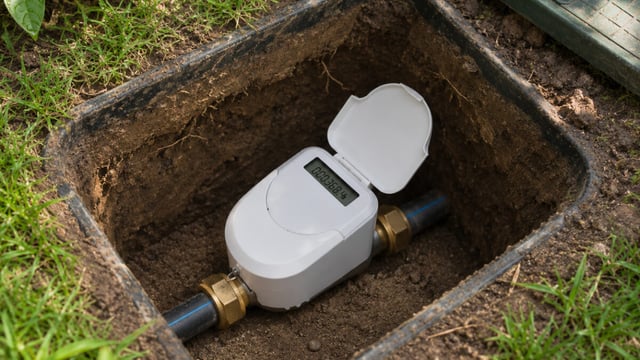
Existing deployments indicate the scale involved: Perpignan Méditerranée Métropole is installing 120,000 Kamstrup flowIQ 2200 meters with acoustic leak detection by 2026, as Kurrantly News reported, while Northumbrian Water in the United Kingdom plans to connect more than one million smart meters to a Siemens meter data management platform by 2030, according to earlier Kurrantly coverage.
Both projects pair meters with a central data platform, which is the layer the consultation found most fragmented across the EU, and the layer EurEau wants built on open standards and common data models rather than a single European platform.
The delegated act due by 12 January 2028 will set the leakage benchmark that the action plan’s metering and data measures will be judged against, and whether the plan’s procurement and interoperability guidance reaches smaller utilities before their two-year action plan window opens will largely determine whether the up to 25% savings estimated by the Commission translate into measured reductions in Infrastructure Leakage Index scores.