in Barcelona
 3 to 5 Nov 2026
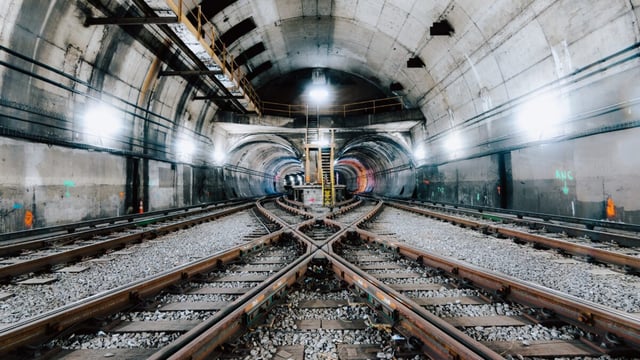
The Metropolitan Transportation Authority (MTA), the New York State public authority that operates the 472-station New York City subway in a city of 8,478,072 residents, wants to fit subway trains with cameras running artificial intelligence analytics that can spot people on the tracks ahead of an approaching train, Gothamist reported on 13 November 2026. The onboard approach sits alongside a station-based track intrusion detection programme that the authority took to market in April 2026 under contract E32521, valued at between $10 million and $50 million, after unauthorised track entries reached 1,297 in 2025, a 22% increase on the 1,062 recorded in 2019.
Track Intrusions Climbed 22% Between 2019 And 2025
According to MTA figures reported by Route Fifty in June 2026, around 6% of subway delays in 2025 were attributed to a person or debris on the tracks. The system logged 491 track intrusions between January and April 2026, against 505 in the same four months of 2025 and a peak of 537 in early 2022.
The human cost shows in collisions. The MTA’s 2022 track trespassing report counted 1,267 subway track incidents in 2021, of which 200 were collisions with trains and 68 were fatal. MTA data released in April 2023 and reported by CBS New York showed at least 88 people killed by trains in 2022.
This project is heading to tender
New smart city and utility tenders worldwide, flagged daily with an AI summary.
“It’s a huge risk to safety and the day-to-day operation of the system,” said Janno Lieber, Chair and Chief Executive Officer of the MTA, in the authority’s February 2022 press release announcing the recommendations of its Track Trespassing Task Force.
Front-Facing Train Cameras Date Back To The 2022 Task Force
The task force, set up on 10 December 2021 and led by Jamie Torres-Springer, President of MTA Construction & Development, recommended exploring front-facing cameras on subway trains because a camera can see much farther into a dark tunnel than a train operator.
The units described in that report combined high-definition cameras with infrared sensors and could feed footage into a video analytics system for automated monitoring. A proof of concept ran on a single L train camera through the Transit Tech Lab, a programme of the Partnership for New York City.
The Long Island Rail Road and Metro-North Railroad already operated front-facing cameras at the time. By April 2023 the MTA was testing front-facing subway cameras that used thermal imaging to detect people or objects in tunnels.
Contract E32521 Tests Detection At Two Stations Over 730 Days
The station-side programme is a two-step design-build procurement issued by MTA Construction and Development on 10 April 2026, according to the contract solicitation notice. Statements of qualifications were due on 15 May 2026, with up to four respondents to be shortlisted for a best-value award in which schedule is a major determining factor.
The 730-day contract, funded entirely by the MTA, covers a laboratory demonstration followed by installation and field testing at one underground and one elevated station, after which the right-of-way equipment is removed and the contractor hands over reusable technical specifications for a wider rollout.
The system must detect accidental falls, intentional entry and dropped objects in the right-of-way, as well as pre-intrusion behaviour such as people leaning over the platform edge or moving erratically, at both low and high passenger densities. Alerts with still images and video go to train operators, station staff and control centre personnel.
Two requirements bear directly on the onboard concept: the solution must integrate with the MTA’s real-time train position data, and it must keep detecting, alerting and recording at station level if the link to the central headend is lost. Torres-Springer told Route Fifty the authority aimed to award the contract by the end of 2026.
Earlier Pilots Failed On Classification Rather Than Detection
The MTA has tested this category before. Between 2014 and 2019 it trialled systems from eight vendors at two subway stations. Six of the eight consistently detected objects of 12 inches or larger, according to the 2022 report.
The systems could not reliably separate people from animals or inanimate objects, so a blowing newspaper could trigger an alert and halt trains, and brief intrusions such as a rider leaning out to look for a train proved hard to capture. A 2022 request for information on track intrusion detection drew 28 vendor responses.
The Transport Workers Union Local 100 has raised the same issue with the new programme, with its safety director questioning to Route Fifty how false positives would be handled and how alerts would tie into existing systems in a network where rats are present throughout.
AI Analytics Spread Across The MTA Camera Estate
In December 2025 the MTA issued request for information 0000532398 seeking a proof of value for real-time AI analysis of video from cameras on subway cars and buses, covering forbidden objects, unattended items and unsafe crowd behaviour, against an estate of more than 15,000 cameras across its stations.
That builds on the behaviour-detection plans Kurrantly reported in May 2025, when the authority said its camera analytics would flag unusual behaviour without using facial recognition.
Physical measures continue in parallel: steel platform-edge barriers were installed at more than 100 stations by the end of 2025, and the MTA plans to reach close to 200 of its 472 stations by the end of 2026. Full platform screen doors were estimated in 2022 at more than $7 billion, in 2018 dollars, for the 128 stations where they were judged feasible.
Comparable Tests In Los Angeles, Chicago And Vancouver
Los Angeles Metro has trialled track intrusion technology on a platform at its Civic Center station, and the Chicago Transit Authority announced camera-based tests at two rail stations in 2025, according to Route Fifty.
On Vancouver’s driverless SkyTrain, platform intrusion detectors are still triggered at times by birds or debris.
A train-mounted camera faces a harder version of that test, since it must classify a figure in a dark tunnel from a moving platform at a range that leaves enough braking distance, and the false-alarm rate it achieves at that range, compared with the station results from contract E32521 after its award, will decide whether the MTA scales either system across a fleet that runs through 472 stations.