in Barcelona
 3 to 5 Nov 2026
The San Francisco Municipal Transportation Agency began accepting permit applications from private EV charging operators on 27 August 2026, formally launching a citywide curbside charging programme that aims to put 100 chargers on public streets by 2030. The launch, announced by the Office of the Mayor alongside the San Francisco Environment Department, converts a two-year pilot into a permanent permitting pathway aimed at the roughly 70% of residents who live in multifamily buildings without private off-street parking.
Two-Phase Permitting Replaces The Pilot’s Case-By-Case Approvals
Applicants must clear an operator permit before touching a site. SFMTA staff screen each company on experience, qualifications, financial readiness and ability to meet reliability requirements, after which the operator is authorised to scout locations across the city.
A separate site permit is then required for every individual charger location. Each site application must include a site plan, installation and equipment specifications, utility verification and a neighbourhood outreach plan, and is subject to a public hearing.
Julie Kirschbaum, SFMTA Director of Transportation, said the full launch would let the agency “apply the valuable lessons learned during the year-long pilot citywide,” in the city’s 27 August 2026 announcement.
The Enabling Ordinance Removes A Public Works Bottleneck
The programme rests on legislation introduced in March 2026 by Mayor Daniel Lurie and Board of Supervisors President Rafael Mandelman. The ordinance authorises SFMTA to permit chargers in the public right of way and exempts applicants from the major and minor encroachment permits normally required by San Francisco Public Works.
Excavation permits under Article 2.4 of the Public Works Code still apply, as do all other City permits. The ordinance also amends the Transportation Code so SFMTA can levy administrative penalties for permit violations, giving the agency an enforcement lever it lacked during the pilot.
Three Utility Pathways Will Shape Project Economics
Operators can energise a site through Hetch Hetchy Power, the publicly owned utility run by the San Francisco Public Utilities Commission, connecting either via the SFPUC-owned grid or through a wholesale distribution tariff arrangement over PG&E’s network. The second route is CleanPowerSF, the city’s community choice aggregation programme, where new charger accounts default to Green service with an optional upgrade to fully renewable SuperGreen supply.
The third route is direct service from PG&E, through either Electric Rule 29, the utility’s EV Power Ready tariff, or Electric Rule 16. SFMTA has published three distinct options for accessing Rule 29 within the tariff’s existing limits, an unusually granular level of interconnection guidance for a municipal permit programme.
SFPUC General Manager Dennis Herrera noted in the launch announcement that the commission supplies roughly 75% of the electricity consumed in San Francisco through CleanPowerSF and Hetch Hetchy Power combined.
Behind-The-Meter Connections Remain The Speed Advantage
Regardless of supplier, chargers connect either by drawing on existing electrical capacity at a nearby building, a behind-the-meter approach, or by installing a dedicated new service connection. The distinction is commercially decisive, because a dedicated connection pulls the project into utility queues that can add months or years.
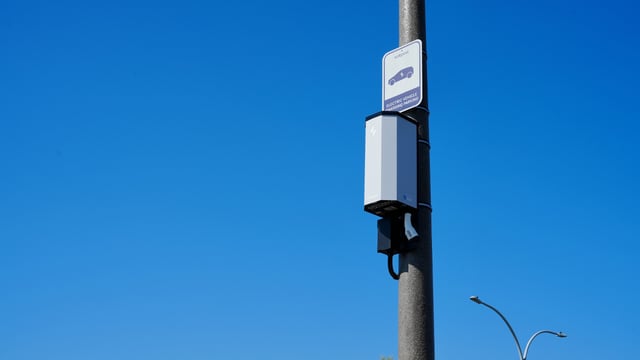
The 2024 to 2026 pilot involved three vendors using different power and installation approaches: Brooklyn-based it’s electric, which sources power behind the meter from host properties, lamppost retrofit specialist Voltpost, and Urban EV. The first two chargers went live at 55 Fillmore Street in Duboce Triangle in April 2025, and the Environment Department has since reported utilisation at those units rising to around 70%.
Both it’s electric and Voltpost also feature in Washington D.C.’s $609,500 curbside charging grant round, an indication that the same small pool of specialist operators is competing across most US curbside markets.
Curb Exclusions Will Narrow The Addressable Site Inventory
SFMTA has signalled it will concentrate chargers in areas with high concentrations of renters and multifamily buildings, and steer away from commercial corridors where Level 2 dwell times fit poorly with turnover. Daylighted corners, Muni stops, coloured curb zones, narrow sidewalks and existing or planned bikeway corridors are excluded.
The agency has published a curbside mapping tool to help applicants pre-screen locations, but warns that the curb data is static and that site visits are required before any location is treated as viable. The Environment Department has separately opened ChargeUp SF, a public nomination map through which residents can propose streets and civic sites.
Bays are shared and first come, first served, with active charging required at all times and standard parking rules including street sweeping still in force. SFMTA will handle 311 complaints, cite operators for permit breaches and enforce parking restrictions at charging stalls.
One Hundred Curbside Points Against A 1,760-Port Requirement
The curbside target is modest relative to the wider gap. San Francisco’s Curbside EV Charging Feasibility Study frames the 100 chargers as one component of an estimated 1,760 public chargers needed by 2030, against a current base of more than 1,300 public off-street ports concentrated in garages.
Those figures sit under a Climate Action Plan that targets 25% of registered private vehicles electric by 2030 and net zero emissions by 2040. EVs and plug-in hybrids have accounted for roughly a third of new vehicle sales in the city in recent years, well ahead of the national rate.
SFMTA is expanding charging on its own estate in parallel, increasing public chargers in its off-street garages from 55 to an expected 305 by fiscal year 2027, and has secured a $5 million California Energy Commission grant for 140 chargers serving its non-revenue fleet.
A Privately Funded Model Sets San Francisco Apart From Peer Cities
Unlike New York, which won a $15 million federal Charging and Fueling Infrastructure grant to install 600 curbside Level 2 chargers, San Francisco is not underwriting the capital. Operators finance, build, own and maintain the equipment, and the city contributes curb space, a streamlined permit and demand data.
That structure limits municipal exposure but transfers siting risk, utility interconnection cost and uptime obligations to vendors whose unit economics at Level 2 remain unproven at scale. The near-term test will be how many operators clear the qualification screen and how quickly site permits convert into energised chargers, with installations expected to begin during 2027.