in Barcelona
 3 to 5 Nov 2026
Starting July 1, 2025, the Siredom syndicate (covering 175 municipalities in Essonne and Seine-et-Marne) will roll out France’s first fully robotized sorting unit powered by Waste Robotics and dedicated to biowaste, in partnership with the mixed-economy company Semardel. Designed to streamline compliance with the Agec law on organic waste separation, the project leverages cutting-edge AI and robotics to identify and extract orange-labeled food waste bags from household garbage streams.
Located on the Vert-le-Grand/Echarcon eco-site, the facility represents a €23.3 million investment, with €1.125 million in support from ADEME (France’s ecological transition agency). Semardel, via its subsidiary Serivel, is responsible for design, build, and operation under a public service delegation (DSP).
How it works:
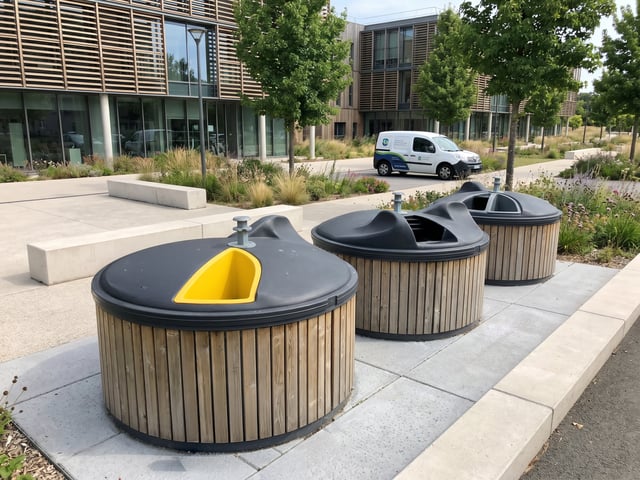
Residents will receive color-coded bags (orange for food waste), which they’ll deposit into regular waste bins. These are collected without changes to logistics—avoiding additional emissions—and transported to the new sorting facility. There, AI-powered vision systems coupled with six autonomous robots across two lines will detect and isolate the organic waste bags. The recovered biowaste is then sent just 500 meters away to a newly built methanizer, also operated by Semardel, to be transformed into biogas for injection into GRDF’s network, or digestate for local agricultural use.
Scaling and Performance:
-
Unit 1 (Operational July 2025): €13.15M, 97,000 t/year capacity, two sorting lines with 3 AI robots each.
-
Unit 2 (Operational January 2026): €11.15M, 48,500 t/year capacity, one sorting line with 3 AI robots.
-
Target: 14,500 t of biowaste/year in Unit 1, 7,250 t in Unit 2.
Already adopted by 32 communes and 4 intercommunalities, the system will serve 485,000 residents by 2026. The technology stack is a result of successful experimentation in Cœur d’Essonne and reflects a push toward full circular economy integration—where residual waste fuels a district heating network and recyclables are reintroduced into the industrial stream.