in Barcelona
 3 to 5 Nov 2026
The Australian Renewable Energy Agency (ARENA) announced on 21 October 2026 that it will fund JET Charge to put up to 130 electric vehicles and bidirectional chargers into the Australian Capital Territory Government fleet in Canberra, in a three-year vehicle-to-grid project called Realising Electric Vehicle-to-Grid Services 2 (REVS2). The Canberra Times puts the total project value at A$5.35 million, made up of A$4.1 million from ARENA and A$1.25 million from JET Charge, although ARENA’s own announcement gives its contribution as A$4 million. ARENA describes REVS2 as the largest commercial vehicle-to-grid deployment in Australia, and the project runs until June 2029.
A Fleet Chosen For Its Overnight Parking
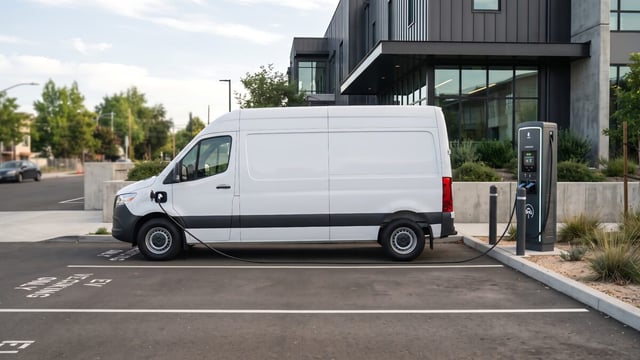
Many of the ACT Government vehicles in the project are used for in-home health services and are typically parked overnight, which gives the trial a predictable window in which cars can be plugged in and exported to the grid without interrupting the work they are bought to do. The question REVS2 is designed to answer is commercial rather than technical: whether a working fleet can reduce its running costs by selling services back to the grid while still meeting its transport needs.
At the maximum of 130 vehicles, the A$5.35 million project value works out at about A$41,154 per vehicle and the ARENA share at about A$31,538 per vehicle, both calculated from the Canberra Times figures. The totals also fund software development and the university research programme, so they are not a per-vehicle hardware cost.
What JET Charge, ActewAGL And ANU Each Deliver
JET Charge leads and delivers the project and will upgrade its charging management software so that charging and discharging can be coordinated around electricity tariffs, vehicle availability and grid needs, according to electrive. ActewAGL will provide a virtual power plant tariff structure, and the Australian National University will study the commercial benefits and share its findings with the fleet sector.
The division of roles places the tariff design with the retailer, the control software with the charging company and the evaluation with an independent university, which matters because the main output of the project is a business case that other fleet operators can test against their own electricity contracts.
The Original REVS Trial As Baseline
REVS2 follows the first Realising Electric Vehicle-to-Grid Services project, which ARENA funded with A$2.4 million in 2020. That trial was led by ActewAGL with JET Charge, Evoenergy, SG Fleet, Nissan, the Australian National University and the ACT Government, and used 51 Nissan Leaf vehicles, according to EV Infrastructure News.
During a February 2024 outage, 16 of those vehicles fed power back to the grid, responding within seconds and returning to normal charging a few minutes later, as reported by the same publication. REVS2 therefore raises the vehicle count from 51 to as many as 130, an increase of up to 155 percent, and moves the objective from demonstrating that discharge works to demonstrating that it pays.
Darren Miller, chief executive of ARENA, said the new project builds on the success of Australia’s first vehicle-to-grid trial, and the agency’s 2025 Bidirectional Charging Roadmap sets the national framework in which the two trials sit.
Why The Commercial Case Is The Open Variable
“Now we need to prove it makes commercial sense,” said Tim Washington, chief executive of JET Charge, in ARENA’s 21 October 2026 announcement of the project. His statement in the same coverage that vehicle-to-grid technology works is consistent with the 2024 outage response, and it frames REVS2 as a test of revenue rather than capability.
ARENA’s 2025 Bidirectional Charging Roadmap estimates, as cited by EVs & Beyond, that if 10 percent of a projected 1.5 million electric vehicles in Australia by 2030 used vehicle-to-grid, they could meet 37 percent of the storage needs of the National Electricity Market. That projection depends on owners and fleet operators earning payments large enough to offset battery cycling, and REVS2 supplies measured fleet data on those payments.
Policy Context In Canberra
Suzanne Orr, the ACT Minister for Climate Change, Environment, Energy and Water, noted that more than 40 percent of vehicles newly registered in the territory in the current financial year are battery electric, according to EV Infrastructure News, so the government fleet sits inside a territory where electric vehicles are already a large share of new registrations.
The announcement coincided with Australia’s first Open Charge Alliance Plugfest in Canberra, an event that tests interoperability, cybersecurity and grid integration between charger manufacturers, charge station management system providers, software developers and energy companies, and which is supported by the ARENA-funded Vehicle-Grid Network project. Interoperability testing of that kind addresses a practical constraint for REVS2, since a fleet trial that depends on one vendor’s chargers and software is harder to replicate than one built on tested open protocols.
Separately, the federal government allocated A$30 million in July to 14 projects under its Grid Enhancing Technologies programme, including vehicle-to-grid and smart EV charging, according to electrive, so REVS2 is one of several publicly funded efforts to make electricity networks more flexible as renewable generation grows.
What The Three Years Will Measure
The project runs to June 2029, and its results will be judged against the 51-vehicle baseline of the first trial and against the 2030 scenario in the Bidirectional Charging Roadmap. The figure that will decide whether the model extends beyond government fleets is the net revenue per vehicle that ActewAGL’s virtual power plant tariff delivers after JET Charge’s coordination software has scheduled each car around its working day.