in Barcelona
 3 to 5 Nov 2026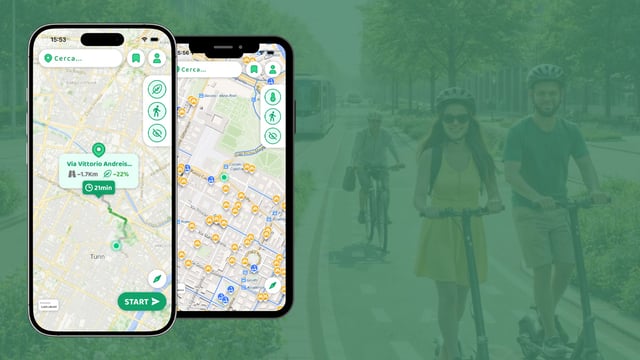
The Città di Torino, the Piedmont capital of 856,745 residents, has been receiving since May 2026 an anonymised dashboard of how residents walk and cycle through the city, generated by Urban Green Navigator, a heat-aware routing app built by Naples-based satellite analytics company Latitudo 40. On 21 September 2026 the company announced a partnership with shared micromobility operator Dott to promote the same app in Milan.
Turin runs the pilot inside its ToMove Living Lab, funded by Italy’s Department for Digital Transformation through the Piano Nazionale Complementare al PNRR, Eco dalle Città reported. The Milan arrangement is narrower: participants in Milano Digital Week, which runs from 30 September to 4 October 2026, get a free Dott ride when they register on the app, and the release says nothing about the Comune di Milano receiving any data.
Disclosure: Kurrant Ventures, the investment vehicle operated by Kurrant, holds a stake in Latitudo 40.
What Turin’s Administration Sees
According to GeoSmart Magazine, aggregated and anonymised user journeys reach municipal administrators as indicators for quantifying carbon dioxide emissions, locating heat islands and detecting infrastructure problems.
Il Fatto Quotidiano described the Turin output in July 2026 as a GDPR-compliant dashboard of resident movement that officials can use to decide where to plant trees or remove paving. The i3P incubator, OGR Torino and Intesa Sanpaolo are among the ToMove ecosystem partners.
About 1,500 users registered in Turin during the first four months, a company-supplied figure reported by Il Fatto Quotidiano, and the app had previously been deployed in Helsinki.
The app is free for residents. Latitudo 40 chief executive Gaetano Volpe told Il Fatto Quotidiano that municipalities and mobility operators are the paying customers, although neither the city nor the company has disclosed what Turin’s pilot costs.
How The Routes Are Built
Urban Green Navigator weights walking and cycling routes by surface temperature, tree cover and air quality as well as by distance and travel time, and typically returns a slightly longer path with more shade and lower temperatures.
“L’algoritmo di Urban Green Navigator, una volta impostata la destinazione, non si limita a fornire distanza e indicazioni stradali, ma integra dati su temperatura, presenza di verde e qualità dell’aria” (“Once the destination is set, the Urban Green Navigator algorithm does more than provide distance and directions: it integrates data on temperature, green cover and air quality”), said Gaetano Volpe, Chief Executive of Latitudo 40, as quoted by Eco dalle Città in May 2026.
The app draws on Sentinel-2 optical and multispectral imagery, refreshed every few days, and MODIS thermal data, with air quality layers at roughly 50 by 50 metres updated hourly, according to Il Fatto Quotidiano. Latitudo 40’s own project description lists Land Surface Temperature and Tree Cover Density among its geospatial layers.
MODIS thermal products have a native resolution of about 1 kilometre, which is coarser than a city block. Street-level heat routing therefore depends on downscaling or on combining sources, and Latitudo 40 has not published a validation of its temperature layers against ground measurements.
Milan Gets The Rides, Not The Dashboard
Urban Green Navigator is the official mobility partner of Milano Digital Week, whose 2026 edition carries the theme “La città generativa”, according to organiser Centro Studi PIM.
Dott reports more than 250,000 shared bikes and e-scooters across over 400 cities in 21 countries, with 10 million users and more than 400 million trips completed, all company-supplied figures. The release does not say whether Dott trip data will flow into Urban Green Navigator.
Dott has used Milan events for rider acquisition before, including a partnership with Segway around the city’s 2026 winter events.
Public money for data-driven mobility already exists in the region. Regione Lombardia allocated €25 million through its “Smart Mobility Data Driven” call to 14 projects led by public administrations, with grants of up to €2.5 million each, as Kurrantly reported, giving Lombardy municipalities a route to buy analytics of this kind outside a single event sponsorship.
Twenty Cities In Talks, With Air Quality Money Available
Volpe told Il Fatto Quotidiano that Latitudo 40 is in discussions with about 20 Italian cities, and that Environment Ministry funding available to cities exceeding particulate limits could pay for deployments.
That pipeline sits against tighter rules, since the recast EU Ambient Air Quality Directive lowers the annual PM2.5 limit to 10 micrograms per cubic metre from 1 January 2030.
Latitudo 40 already works with public bodies elsewhere in Italy, including Rome’s ESA and AMA pilot on illegal dumping and urban heat islands.