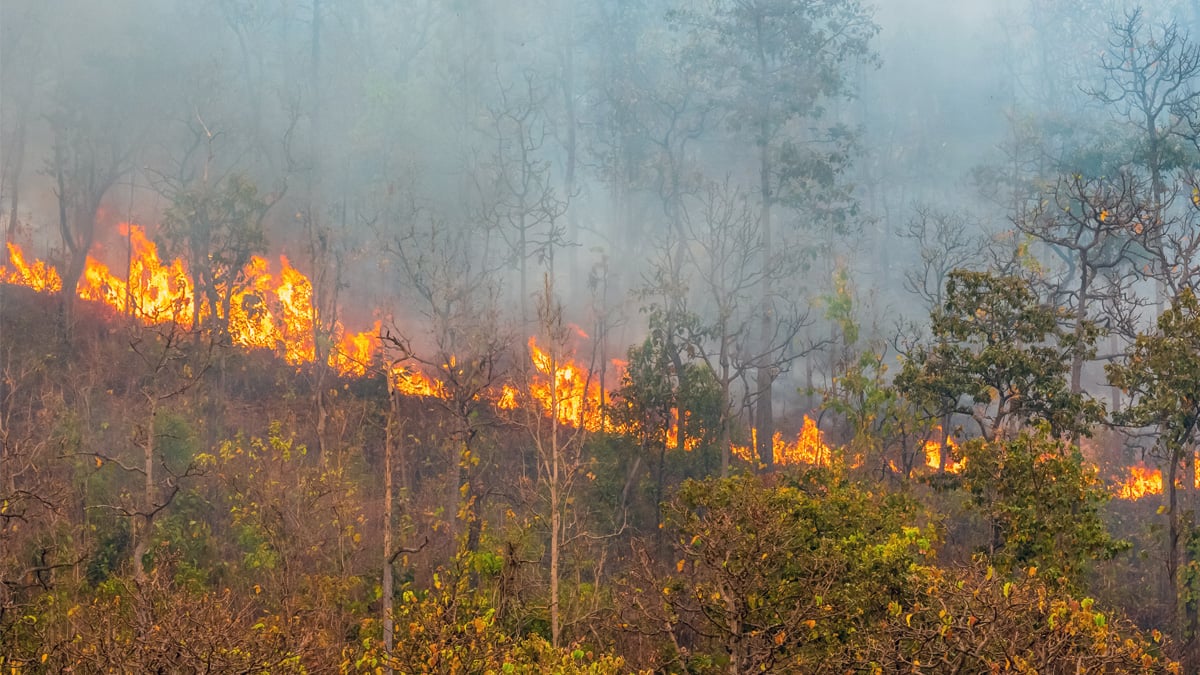
Croatia’s Ministry of Environmental Protection and Green Transition announced on 24 August 2026 that the national video surveillance system for early detection of forest and forest-land fires has been extended by 50 monitoring cameras across 25 new locations, weighted toward protected areas including national parks and nature parks. The expansion was delivered under the project “Establishment of a Central Point for Coordinated Implementation of Climate Change Adaptation Policies,” with the service supplied by state-owned transmission infrastructure operator Odašiljači i veze d.o.o. and funding drawn from the EU-backed Competitiveness and Cohesion Programme 2021 to 2027. The stated purpose is faster ignition detection and better-informed dispatch decisions as fire seasons lengthen.
Why Protected Areas Moved To The Front Of The Detection Queue
Croatia’s earlier camera rollouts concentrated on commercially managed state forest, leaving conservation land comparatively thinly covered. Redirecting this tranche toward national parks and nature parks closes a gap that matters operationally, since these areas combine difficult access, high fuel loads and heavy summer visitor numbers.
The choice also tracks European exposure data. The Joint Research Centre reported that 2025 was the EU’s worst recorded fire season, with 1,079,538 hectares burnt across 25 member states, and that roughly 39 percent of that burnt area fell inside the Natura 2000 protected site network.
“By establishing new locations, the capacity for timely fire detection, assessment of its development and potential spread, and rapid field response is further strengthened,” the Ministry of Environmental Protection and Green Transition said in its 24 August 2026 announcement.
How Fire Detect AI Converts Camera Feeds Into County Dispatch Decisions
The deployment uses OIV Fire Detect AI, built around panoramic high-definition cameras mounted on the operator’s existing antenna towers, cloud-hosted image analysis, and a supervisory operations centre. The detection algorithms target smoke plumes in daylight and flame signatures at night, giving continuous cover rather than seasonal daytime watch.
Two design details distinguish this generation from earlier fire-watch cameras. Meteorological data is fed into the same platform so that risk scoring and spread estimation sit alongside the raw detection alert, and the OIV product documentation describes built-in fire spread simulation as part of the toolset.
Image and data streams are routed to every county firefighting operations centre, which is the practical test of any detection network. Detection without an integration path into dispatch adds latency rather than removing it.
OIV Supplies A Managed Service, Not A Camera Order
The Ministry describes OIV as the service provider, not merely a hardware vendor, which places tower access, backhaul, redundancy and technical maintenance inside a single contract. That structure is unusual in European wildfire detection, where municipalities more commonly buy camera stations and then negotiate connectivity separately.
The underlying smoke and fire recognition algorithm was developed with the Faculty of Electrical Engineering, Mechanical Engineering and Naval Architecture in Split, according to OIV’s own project description. The domestic research base and the reuse of broadcast tower estate are the two cost levers that make the Croatian model difficult to benchmark directly against commercial subscription platforms.
Cohesion Funding Attaches A Number To The Wider Climate Programme
The parent project is led by the Institute for Environmental Protection and Nature within the Ministry, with Hrvatske vode as partner. The Ministry stated in 2025 that total eligible costs run to 8.23 million euros, of which 6.99 million euros is grant funding, with national co-financing budgeted across 2025 to 2027.
Camera upgrades are one workstream inside that envelope rather than its whole purpose, so the per-site cost of this expansion has not been published. Croatia’s Central Finance and Contracting Agency has reported contracting 84 projects worth 391.6 million euros under Priority 3 of the Competitiveness and Cohesion Programme, the same priority axis that covers climate adaptation and risk prevention.
FIRESTOP Sets The Domestic Cost And Coverage Benchmark
The closest comparable is FIRESTOP, run by state forestry company Hrvatske šume and presented in Zadar in May 2026. That project installed 82 cameras at 41 locations across nine counties, covering an additional 95,488 hectares of state forest, at a total value of 3,249,471.29 euros with 2,640,848.71 euros from EU cohesion funds.
FIRESTOP works out at roughly 79,000 euros per location and about 34 euros per hectare of newly covered forest, a useful yardstick for utilities and agencies scoping similar networks. Hrvatske šume has attributed measurable results to the surveillance system operational since 2018, citing a 58 percent fall in forest fire numbers over eight years and a 33 percent reduction in average burnt area against the 1992 to 2017 baseline.
Where Croatia Sits Against Other European And US Deployments
Croatia’s approach is state-led and infrastructure-anchored, which contrasts with the vendor-subscription model dominant in North America and the municipal pilots spreading across the Mediterranean. Kurrant has documented the 15-station FireWatch AI network commissioned by the Municipality of Paralimni-Deryneia in Cyprus, a comparable visual-analysis deployment operating at municipal rather than national scale.
Sensor diversification is the emerging counter-trend. Kurrant’s coverage of the City of Irvine’s planned SensoRy AI sensor network shows agencies adding non-optical detection to fill camera sightline gaps, an option Croatia has not yet signalled for its karst and island terrain where line of sight is frequently obstructed