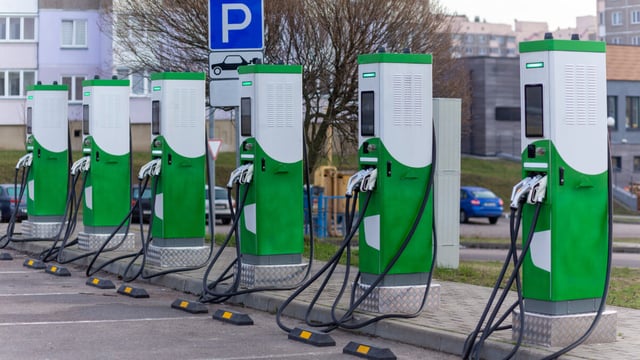
East Ayrshire Council, North Ayrshire Council and South Ayrshire Council in southwest Scotland have agreed a 15-year partnership with the charge point operator Believ to install more than 600 public charging points at approximately 300 locations, backed by more than £2.8 million from the Scottish Government’s Electric Vehicle Infrastructure Fund and more than £15 million of capital that Believ has committed itself, as reported on 7 October 2026.
The first new charge points are expected to be installed from early 2027, and the contract also hands Believ the operation and maintenance of the existing ChargePlace Scotland chargers in all three council areas, according to Zapmap.
A Concession Divided Almost Evenly Between Three Councils
The announced allocation gives East Ayrshire around 180 chargers, North Ayrshire around 210 and South Ayrshire around 220, which sums to 610 and is consistent with the “more than 600” headline figure, and the network is described as covering urban, rural and island communities including the Isle of Arran.
Each council area is to receive at least five accessible charging locations, and the mix of hardware ranges from what Zapmap describes as Standard Plus units suited to longer stays up to rapid chargers, although no kilowatt ratings have been published for either category.
The programme is delivered with Transport Scotland and the Scottish Futures Trust, and it is described as the first public sector partnership in Scotland for Believ, which currently operates more than 2,300 public charging points across the UK.
Private Capital Outweighs Public Funding By More Than Five To One
The figures published so far imply that the Scottish Government contribution represents 15.7 per cent of the combined £17.8 million in stated funding, with Believ carrying the remainder, and because both figures are given as minimums the true ratio could differ in either direction.
Dividing the combined stated funding by 600 chargers gives an average of about £29,667 per charge point, a derived figure that should be treated as an upper bound on unit cost because the private capital also covers the takeover of existing assets and the passive provision described below.
The Electric Vehicle Infrastructure Fund is the mechanism through which councils pool demand and attract operator investment, and Scotland’s Cabinet Secretary for Economy, Tourism and Transport, Stephen Flynn, said he was delighted that the £2.8 million would support 600 new chargers in Ayrshire.
Passive Provision Prepares More Than 450 Locations For Later Expansion
Beyond the 600 active chargers, the contract includes passive provision at more than 450 locations, meaning that ducting and electrical capacity are installed so that further chargers can be added later without repeating civil works, which is the part of the programme most dependent on future demand.
This approach shifts the cost of grid reinforcement and trenching to the front of the contract, and it is the main reason the 15-year term matters, since an operator has to recover that early outlay from charging revenue over a period long enough to cover several generations of vehicle and charger technology.
Believ Is Scaling Through Public Sector Contracts Elsewhere
In June 2026, Hampshire County Council selected Believ to deploy 17,180 public charge points, which was described as the largest contract in the UK backed by the Local Electric Vehicle Infrastructure fund, and the Ayrshire award is roughly 3.5 per cent of that volume by charger count.
Believ’s wider expansion is backed by a £300 million investment first announced in 2025, which the company has said will fund at least 30,000 additional public charge points across the UK, so that the Ayrshire commitment of more than £15 million sits inside a much larger funding programme.
“We’re proud to be supporting the region in expanding access to reliable and accessible EV charging across the region,” said Guy Bartlett, Chief Executive Officer of Believ, in comments published by electrive on 7 October 2026.