 in Barcelona
 3 to 5 Nov 2026
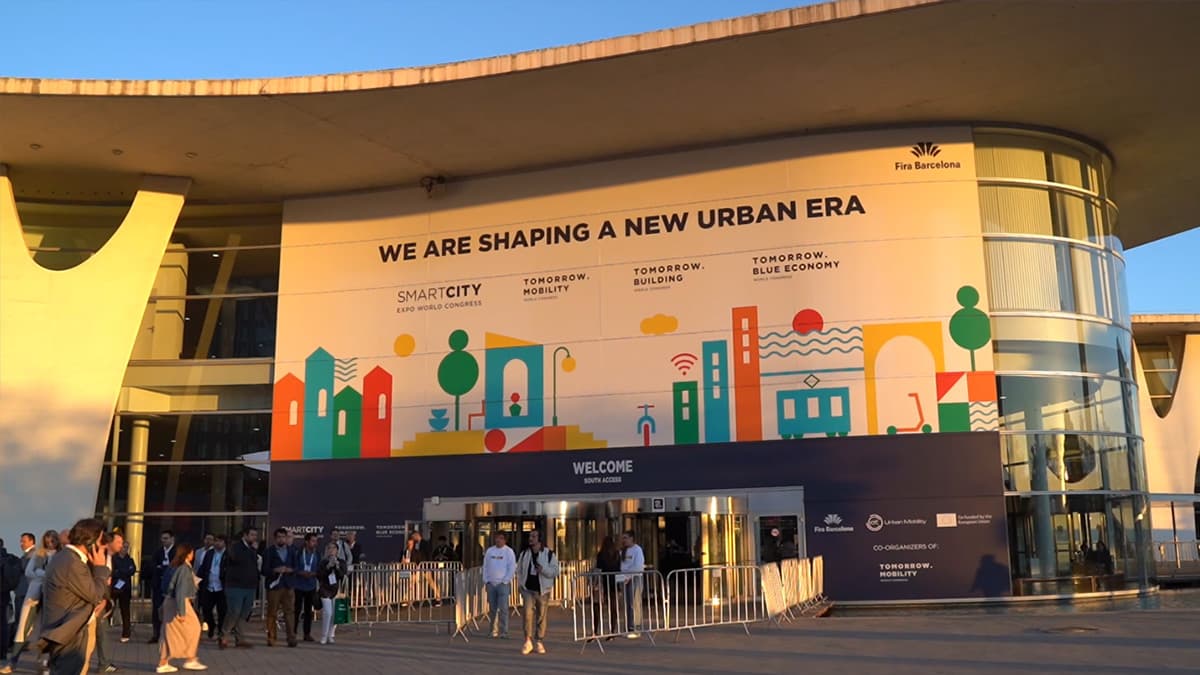
Smart City Expo World Congress Barcelona 2026
Smart City Expo World Congress 2026, Barcelona, 3 to 5 November. Kurrant films the expo floor, interviews with city and utility leaders and the companies that work with them, and The Smart Deal live pitches at Booth D151 in Pavilion 3. Videos are added here as we film them.
Jennifer Sanders, North Texas Innovation Alliance: innovation at regional scale
Jennifer Sanders, Executive Director of the North Texas Innovation Alliance (NTXIA), explains why smart city innovation may need to happen at regional scale. With 30% of North Texans crossing at least one county line every day, she argues that cities need shared standards from the start, including for privacy and the use of AI, and describes public safety agencies that already share data under common agreements. She talks about why successful pilots stall without a plan and budget for what comes next, how cities such as Frisco and McKinney prepare shared problem statements for the Smart Cities Global Startup Challenge, and the work of the Internet for North Texas coalition to help smaller cities bundle broadband procurement. She highlights the regional decision to designate broadband as a mode of transportation, so connectivity can be part of every transport project, discusses how cities can balance the benefits and the power, water and infrastructure demands of data centers, and where regional data sharing helps most, from energy and water to emergency response. She closes with lessons on building coalitions from her book, The Science and Soul of Innovation.
Interviewed by Emma Lozano Doogan on the Kurrant booth at Smart City Expo World Congress 2026, Barcelona.
📖 Read Video Transcript
We're back at the Kurrant
booth for another interview.
2
We're here with Jen Sanders.
3
She is executive director of
North Texas Innovation Alliance.
4
We're going to be talking
about why innovation
5
may need to happen at regional scale.
6
The smart city industry
has traditionally focused
7
on individual cities
launching their own projects.
8
Why do you believe regional
collaboration rather than individual
9
city projects is becoming more
important for smart city innovation?
10
Well, I think there's always
going to be a place at the
11
city level, but what we
really try and do is how do we
12
support individual cities in
making sure that strategically
13
the region is working in
alignment from a standards
14
perspective and really can
find the efficiencies to
15
make sure cross-jurisdictionally
everything is working.
16
And if you don't look at
that at the beginning,
17
you're going to have to
redo a lot of things later.
18
So we're trying to get ahead
of any mistakes that are made.
19
I recently had an interview with
the city of Valencia where they
20
said that the city, you know,
residents or people who go to a city,
21
their lives doesn't just stop
at the border of the city.
22
You know, it keeps going.
23
So that they said they
were— we would talk about
24
smart territories
instead of smart cities.
25
So how could North Texas cities
benefit from joint procurement,
26
shared technology standards, and
infrastructure for that collaboration?
27
Well, I think Valencia
is absolutely right.
28
And we often say, you
know, 30% of North Texans
29
cross at least one
county line every day.
30
And so they don't care.
31
They want the traffic signals to work.
32
They want public safety to be able
to reach them in an emergency.
33
And so what we do know is that
jurisdictionally, we need— again,
34
we need the standards, to
your point, especially right
35
now as we look at privacy
implications and how are cities
36
utilizing AI in a way that
can benefit the whole region.
37
There's some public safety entities
throughout North Texas that
38
work collaboratively and have
those agreements so that the
39
way data is shared is consistent
and consistently structured and,
40
and, and constructed from a
privacy and use perspective.
41
Okay.
42
And through initiatives
like the Smart Cities Global
43
Startup Challenge, NTXIA
connects startups with cities.
44
What's stopping successful pilots
from scaling across the region?
45
Well, I think— it sounds like cheating,
46
but it's financial and
it's planning, right?
47
And so part of the reason everyone
got tired of what everyone called
48
pilot paralysis is because there
wasn't a plan for after the pilot.
49
There wasn't budget set
aside to implement more
50
widely the things that
worked and understand that.
51
And so I think that
is the largest piece.
52
So regionally, cities like Frisco
and McKinney that we work with
53
on that challenge, they have
predetermined what the similar
54
problem statements, what the
similar challenges they want to
55
solve for are, and they know that
they're ready because they've
56
been collaborating since before
the challenge is designed.
57
So those are the type of steps that
I think really make a difference.
58
And through the Internet
for North Texas Coalition,
59
you're involved in a lot of— yeah,
60
you're working on
digital connectivity.
61
Should broadband be
treated as public utility,
62
and how would that change
regional investment?
63
No, absolutely.
64
I think broadband is
considered a utility.
65
The difference is that it's a mix
of public and private ownership.
66
And so part of what the Internet
for North Texas works to do
67
is provide the resources and
the education, particularly to
68
smaller cities and smaller
towns, to make sure that they get
69
the efficiencies of scale where
they may not be getting the—
70
they may not be getting the
attention of the larger providers.
71
But so to your point, how do we
bundle that type of procurement
72
in a way that, one, has the
standards built in, and two,
73
makes it possible for smaller
cities to be able to do it.
74
And the one other thing that
I think is really innovative
75
for our regional government
system is that they
76
designated broadband as
a mode of transportation.
77
And so what that means
is any transportation
78
funding that they put
out, connectivity can
79
and should be part of
that project design.
80
And so that, I think, is
very innovative in the US.
81
With growing interest
in AI and data centers,
82
how should cities balance
economic benefits against
83
electricity, water,
infrastructure demands?
84
I think that's a million-dollar
question right now.
85
And, and I think Texas, I think,
is the second state behind the D.C.
86
area and the number of data centers
that are here or planned for here.
87
And I think part of the, part of the
piece is how our economic development
88
incentives structured, because
I think it needs to be designed
89
differently than perhaps traditional
economic development has been.
90
I think in talking to hyperscalers
about how can you really
91
demonstrate to communities
that you're invested here,
92
looking at more permanent investments
like the building of housing
93
and that kind of an investment
surrounding the data centers.
94
Obviously, bring your
own power is a large
95
piece now, but there's still concerns.
96
And so I think the big piece
is how flexible are the
97
hyperscalers willing to be and
how can we meet in the middle?
98
Because broadband was very similar
actually from the standpoint
99
of the private sector said
this is the city's problem,
100
the city said this is the
private sector's problem,
101
and getting in a room and saying
it's okay if both things are true.
102
We know that you need to make profits.
103
We know that you need to
take care of residents.
104
Those things don't have
to be mutually exclusive.
105
We can find a middle ground
to get all of this done.
106
I think data centers is going to
need to operate in much the same way.
107
Of course, so that it
can benefit everyone.
108
It's a simple but not easy philosophy,
109
but I think you just
need to be honest.
110
Yeah.
111
And where could better regional
data sharing make the biggest
112
difference to electricity, water,
transport, and telecom networks?
113
So I think the great news is the
single electricity distributor,
114
Oncor, has a vast— they
use their data very wisely.
115
They're very mature in that.
116
So when we think about looking at that
and from the planning perspective,
117
they cover the whole region
or almost the entire region.
118
So you already have that
standardization of data.
119
And I think, you know, the
biggest impact I think will be
120
on those key natural resources,
energy, water, broadband.
121
And then we're seeing so many
more extreme weather events.
122
So how is emergency response tied
into all of these connected networks?
123
And I think AI can really help train
models that make us more prepared.
124
How can cities ensure
partnerships with technology
125
companies that deliver
lasting public value?
126
I think the private-public
collaboration is always a bit
127
tricky, rather than just creating
new markets for suppliers?
128
So one thing that, you know,
there's so much hesitation
129
from cities in terms of getting
into these partnerships.
130
And some of the things— one of the
things that I have said to cities
131
before is this isn't new, it's
just a new type of investment.
132
So there's a lot of public-private
partnerships and things like
133
large park projects, large
infrastructure projects in that way.
134
And so it's, it's, it's not the
same, but that worked and it
135
created public benefit and
there was a revenue structure.
136
And so I think if you can
look at a situation that was
137
less scary but the same
model, there are certainly
138
ways to build, to build
structures on these larger
139
infrastructure projects that
can have similar benefit.
140
And then for my
last question,
141
I wanted to talk to you
about your book.
142
So in your book, The Science
and Soul of Innovation,
143
you explore the challenges
of building coalitions.
144
What's the biggest
mistake cities make when
145
bringing different
organizations together,
146
and what's the— what's
your most important lesson?
147
I think there, there are so many,
but, but one I think is on both,
148
both the public and private
side is not— is being afraid to
149
ask questions or not asking the
right questions at the beginning.
150
And so what a lot of cities
that I work with will not,
151
you know, will be— think
that they sound dumb or
152
that they're not in the same
place, so they won't want
153
to ask the questions that
they need the answers to.
154
And we can kind of be a conduit
to gather those and make sure
155
that everyone is on the same
page, everyone is prepared.
156
And if you don't ask those questions,
you end up moving forward with
157
something that you might have known
at the beginning was not going to
158
work in your city, either because
of systems you had or otherwise.
159
So I think the first
is asking, asking a lot
160
of questions and finding
that common ground.
161
And then I think identifying where
are the investments already planned
162
so the private sector can be able
to work their models and come to
163
the table with what they're willing
to do, what's important to them.
164
And if they don't think it's going
to work, that they share that too.
165
So a lot of listening, a lot of
trust, a lot of question asking,
166
and then making sure that you
know where your resources are,
167
I think, are some of
the important lessons.
168
Well, for those who are
scared of asking a question,
169
because they think they'll look dumb.
170
In Germany, there's a song for
kids that says, who, how, what?
171
If you don't ask, you stay dumb.
172
So that's perfect.
173
I'm going to use it.
174
I'm German, so I feel, I
feel like it's natural.
175
There you go.
176
Well, thank you so much
for the conversation.
177
Thank you so much for having me.
About Smart City Expo World Congress Barcelona 2026
Smart City Expo World Congress 2026, Barcelona, 3 to 5 November. Kurrant films the expo floor, interviews with city and utility leaders and the companies that work with them, and The Smart Deal live pitches at Booth D151 in Pavilion 3. Videos are added here as we film them.
More Smart City Expo World Congress Barcelona editions




Latest Kurrantly News
All news Intellihub Acquires Taggle Systems For A$50M To Add Water Metering Network And Aqualus Software
 Quincy Replaces 50 Flock Safety License Plate Cameras With Axis Hardware Running OdinEye
 Modaxo Acquires Brazilian Traffic And Tolling Supplier Fiscaltech
 Aléria Closes €793,236.52 Street Lighting Renovation Backed By State, Corsican Agency And EDF
 Hameln-Pyrmont Tenders Open Source Urban Data Platform
 Landkreis Hof Opens TauSENSE App To Public Using Data From 130 Road Dew-Point Sensors
Latest Kurrant Originals
See all

Kurrant advisory
Planning a smart city or utility project? Talk to Kurrant.
Behind these interviews is Kurrant's advisory team, working with utilities, cities and the companies that serve them.
- Strategy AdvisoryKurrant is actively involved in resolving the challenges that cities, utilities and industry players are facing.
- M&A AdvisorySmart city and utility expertise for successful deals, turning insights into strategic gains.
- Engineering & ProcurementBetter engineering and procurement decisions, by identifying and developing digital and IoT solutions across use cases.
Or write to us: contact@kurrant.com
Send us a message
© Kurrant. All Rights Reserved. · Editorial Standards · Cookie settings
This site is protected by reCAPTCHA and the Google Privacy Policy and Terms of Service apply.