 in Barcelona
 3 to 5 Nov 2026
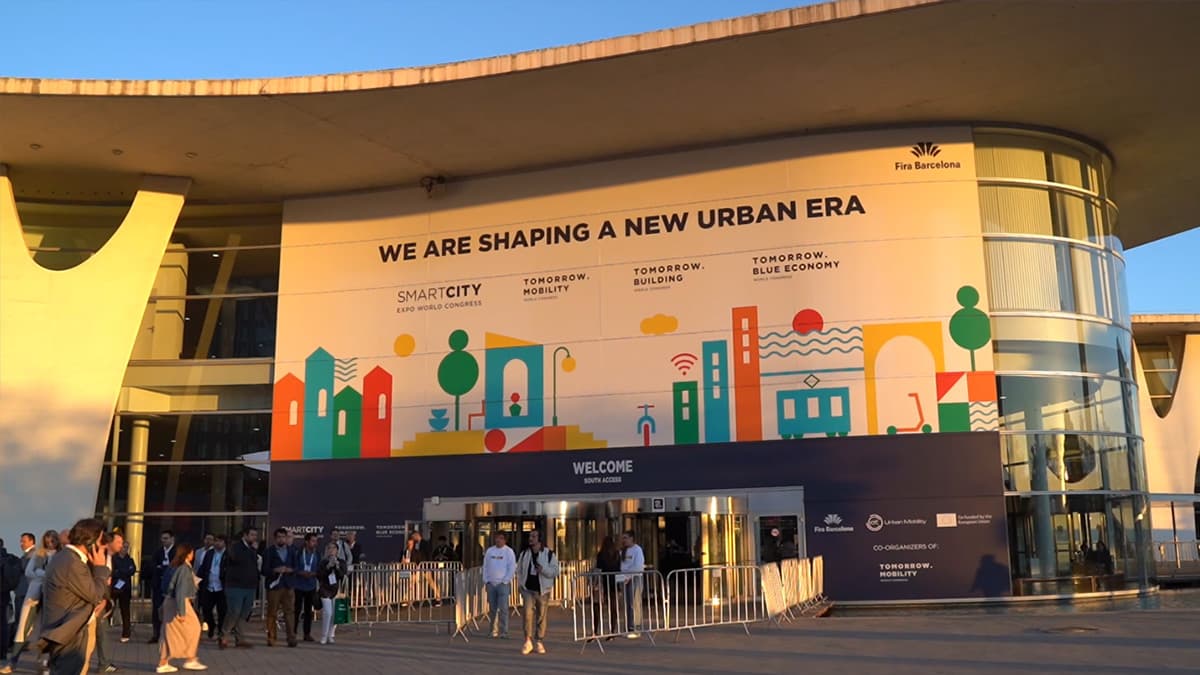
Smart City Expo World Congress Barcelona 2026
Smart City Expo World Congress 2026, Barcelona, 3 to 5 November. Kurrant films the expo floor, interviews with city and utility leaders and the companies that work with them, and The Smart Deal live pitches at Booth D151 in Pavilion 3. Videos are added here as we film them.
Turning city strategies into real results
What do cities need to turn ambitious strategies into real results? On the Kurrant booth, World Economic Forum Senior Director Ramya Krishnaswamy, Jon Williams, Partner for Cities and International Development at KPMG, and Tiffany St James, Chief AI Officer at Liverpool City Region, answer questions from Emma Lozano Doogan of Kurrant.
Ramya Krishnaswamy says cities that deliver have political will, a budget and a deadline. Jon Williams explains what brings in private money: skin in the game, certainty in returns, and portfolios of projects instead of single ones. Tiffany St James shows how Liverpool City Region uses AI in its control centres to find road near misses, and why cities should define the problem before they choose an AI solution.
The panel also looks at why city governments and investors do not yet speak the same language, and what makes public-private collaboration work: trust, transparency and shared outcomes. Tiffany St James closes on why AI in local government is a leadership challenge, not just a technology rollout.
Recorded at Smart City Expo World Congress 2026, Barcelona.
📖 Read Video Transcript
But it's really interesting that technology
and AI is seen as a technology rollout
2
and it's not as a leadership challenge.
3
We are back at the Kurrant booth.
4
We're going to be exploring
what cities need
5
to turn ambitious strategies
into real results,
6
So first of all, I would
like to start with Ramya.
7
Looking globally, what separates
cities that successfully
8
turn ambitious strategies
into real results
9
from those that struggle to
move beyond the planning?
10
Well, I find that when
cities have certain
11
ambitious plans and
strategies, there's at
12
least 3 things that
need to go really well.
13
First, they need political will.
14
This needs to be prioritized.
15
It's really important for them.
16
They need to get it done, and it's
something that citizens really want.
17
So there's really a political
will to make something happen.
18
Then there is the budget,
obviously, which is— we need to be
19
able to put the resources
behind getting something right.
20
And oftentimes really
having the
21
right budget needed to
see something through.
22
And I'd say the last but
not least, a deadline.
23
Nothing like a deadline, right?
24
So, you know, this is
where I find there are
25
ways in which to actually
create that urgency.
26
The deadline really helps
translate the will and
27
the resources to actually
make things happen.
28
And examples of this for me,
when I see cities that want
29
to be hosts of major events
that really come to them,
30
typically it's these 3 things
where they have a will
31
to make something happen, they
have the resources for it,
32
and they actually have a
deadline to deliver around.
33
And then what they need
to eventually do is ensure
34
that it works for their
citizens and as well for
35
the visitors that are
going to be a part of it.
36
That's the tension they manage
around this particular case.
37
And then, Jon, cities have
ambitious infrastructure
38
plans but limited budgets, as we know.
39
What needs to change
to attract more private
40
investment and actually
deliver these projects?
41
What a great question.
42
I think I'll stick to
the 3 points as well.
43
So I think in my mind, to
initiate that conversation,
44
to think through how
cities put skin in the game
45
and demonstrate their
enthusiasm to participate
46
with private money, I think,
is massively important.
47
So I'd kind of go a little
bit with skin in the game.
48
I would also then say something
about certainty in returns.
49
Clearly attracting global
money into local circumstances
50
and local infrastructure
becomes really important.
51
So you've got to have
a really razor-sharp
52
commercial edge to that conversation.
53
And then I think my final
point would be one that
54
really tries to demonstrate
scale rather than
55
conversations around
we've got a great project.
56
I think you get a much stronger
appetite, a much richer conversation
57
if you're talking about place and
projects and portfolios of projects
58
rather than we need one, a little
bit of help on this one please.
59
Those would be my 3 things.
60
I couldn't agree more.
61
Thank you.
62
When we talk about smart cities,
we talk about strategies,
63
we talk about budgets, and I think
64
nowadays we can't go on
without talking about AI.
65
Tiffany, AI and digital technology
are advancing very quickly.
66
Where can cities make
the biggest practical
67
improvements to public services today?
68
I don't think there's
necessarily one answer to that,
69
and I regularly speak with
a range of different cities.
70
We've all got a certain flavor.
71
Now, we're very fortunate in
Liverpool City Region that we
72
own most of our transport,
so actually moving goods and
73
people around safely, getting
them to work, getting them to
74
hospital appointments, is
really key and critical for us.
75
And because we can
own the data for that,
76
we can make some really
interesting maneuvers,
77
if you'll forgive the wording,
in our transport arrangements.
78
But I think every city has
a responsibility to look at
79
health and social care, to
be able to look at jobs and
80
economy and investment and
impact in economic growth.
81
My portfolio stretches, of
course, to education as well.
82
So how do we look at using AI
within the schools adjacent to
83
the curriculum teaching our
headteachers to be strategic consumers
84
of AI so that we can affect the
whole talent pipeline across
85
from younger people right the
way through to working areas.
86
So there's not one answer in terms of
87
what cities should be tackling first.
88
It's looking at your
strategic imperatives for your
89
particular region and then
looking at where AI can help
90
address the challenges
that you have within that.
91
And then Ramya, are cities
embracing solutions without
92
defining the problem first
and what needs to change?
93
I think I really want to build
on what you just said, Tiffany.
94
It's at least today as
I've gone around the Smart
95
City Expo, there's a
lot of discussion on AI.
96
Part of what, in a way, if I
were to share a concern I have,
97
is that there's a lot of them that
are thinking about AI but without
98
actually thinking through what
problems do we need to solve
99
for the city and how can AI
actually enable that solve, right?
100
So this is why I really want to take
a little bit of a step back to say,
101
what are the citizen services
that we really need to offer more?
102
Do we have data that actually
helps us unlock a good
103
sense of these are the problems
we are looking to solve?
104
Ahead of actually investing in the
tech stack or the GPU that they
105
need to build or thinking about the
applications they need to develop.
106
So for me, I want to go back
to the emphasis on taking the
107
time to define the problem and
identifying what we solve for
108
before actually jumping into
that build or that solution.
109
So I don't know.
110
Absolutely right.
111
So we, I mean, we start with
the strategic imperatives
112
in terms of, you know, we
have a like many mayoral
113
strategic authorities, a
responsibility to reduce accidental
114
collisions that result
in death to zero by 2040.
115
Many mayoral strategic
authorities have that.
116
So by using AI in our visual
language models now in
117
our control centers to chat
with video, we can get to
118
those near misses where
collisions are only reported.
119
So that is a real problem, but
it's also a strategic imperative.
120
But not enough focus is on
the problems to start with.
121
I absolutely agree with you,
122
and it is what we're looking at.
123
So thank you.
124
Maybe I'll just do one quick build,
125
which also ties back to what
you were saying earlier.
126
If you take the other part of cities,
several governments around the
127
world are highly indebted, and
therefore private capital needs to
128
come into cities and some of their
biggest strategic imperatives.
129
The other piece I feel we need
to spend more time thinking
130
about is what is going
to make private sector,
131
especially the investors,
understand the need for why they
132
need to be participating
in some of these projects.
133
And there I see they're not
speaking the same language.
134
So for me, there the solve is
around, is there a way for city
135
governments and also the private
sector and the private capital to be
136
trying to understand better how
do they solve for it together and
137
what still needs to happen in
terms of various types of capital?
138
And it's perhaps why I started
my answer by saying, you know,
139
the public sector can't stand
back and wait for crowding unless
140
it actually demonstrates a
little bit of skin in the game.
141
So to the point that was
originally raised around
142
tight budgets, how do
you really optimize?
143
How do you really think about
initiating how you spend that
144
scarce money to think about how
you crowd in and tell a story.
145
And it really is an
undercurrent to the piece
146
that says we're telling
a story about place.
147
We don't want to tell a story
about a particular intervention.
148
And I don't think government
is probably doing as good a job
149
as it could do, potentially
should do, around describing what
150
the benefit for business is in
that long-term participation.
151
So, you know, this bit about
investing in cash is one thing.
152
The piece around what that means to
the future of collaboration and growth
153
of business and how business succeeds
through this investment over time,
154
I think, is a story we could all
do better to describe and explain.
155
We can't do this alone.
156
We absolutely need to
work and collaborate with
157
partners across what we
call the quadruple helix.
158
So academia, government, businesses,
but also our residents and
159
citizens are getting their points,
which is something that you
160
raised as well, Ramya, getting that
citizen voice and the residents'
161
ideas into what is right and
beneficial for themselves too.
162
And Jon, well, since we
were talking about
163
the private-public collaboration,
we know there are challenges,
164
but in your experience with
the projects you've seen,
165
when was it— when was that
collaboration successful?
166
Well, it builds wonderfully on the
167
conversation we've
just had, doesn't it?
168
I think the point around the nature
of that collaboration and the
169
extent to which it's a trusted
collaboration— clearly,
170
if we're getting into transactions,
if we're getting into setting up SPVs
171
and other vehicles, actually
there needs to be a sense of where
172
the incentives, where the demand,
what the need, what the education,
173
how people are going to
participate, how you manage risk.
174
So my answer to the question
is a word that you used
175
in the question, which
is the point around the
176
strength and the transparency
of that collaboration.
177
It's, you know, the finesse
of bringing the right capital
178
to the right projects at
the right time to do the
179
right thing is a deeply complex
transactional capability.
180
But actually, if there's trust in
a relationship, actually, you know,
181
you're not going to get it
perfectly right all of the time.
182
But the overriding sense of how
that all plays out, I think,
183
is where we've seen it kind of
come together in the best ways.
184
Your question around PPPs are
about addressing proper outcomes.
185
So finance and all of these other
stakeholders have to come together,
186
have to trust the collaboration,
and have to recognize that
187
actually it's a long-term venture
and that is about outcomes.
188
It's not about the individual
roles that you play,
189
it's about the joint outcome
that you're striving to achieve.
190
And then the last question,
Tiffany, is the biggest obstacle
191
to digital transformation
the technology really,
192
or the inability of local
government to change how they work?
193
It's a good question and it's quite
strong because I would say
194
in no circumstances is there
inability for public sector and local
195
authorities or combined authorities
to change the way they work.
196
But it's really interesting that
technology and AI is seen as
197
a technology rollout and it's
not as a leadership challenge.
198
And actually having critical thinking,
having human skills to challenge
199
very polished outputs, to challenge
technology that is perhaps not as
200
well understood by different parts
of leadership is absolutely critical.
201
And we have to, within
the public sector,
202
to build trust very
quickly with internally,
203
with residents and citizens, with,
204
you know, our suppliers and partners.
205
But equally, we have to
ensure that we are being very
206
considered and very responsible
in the work that we're doing.
207
And therefore, public sector is
seen as is taking less risks because
208
we're not rewarded commercially for
doing it within the public sector.
209
But it's really important we
get that right because of the
210
responsibility of public data and,
you know, public service delivery.
211
But therefore, one of the
things that I'm trying to do as
212
a leadership psychologist, as
well as a Chief AI Officer,
213
is to create conditions for
innovation in the age of AI.
214
And that is about taking
that leadership challenge.
215
Well, thank you very
much to the 3 of you.
216
It was great to hear your answers.
217
Thank you. Thank you so much.
Thank you very much. Thanks very much.
About Smart City Expo World Congress Barcelona 2026
Smart City Expo World Congress 2026, Barcelona, 3 to 5 November. Kurrant films the expo floor, interviews with city and utility leaders and the companies that work with them, and The Smart Deal live pitches at Booth D151 in Pavilion 3. Videos are added here as we film them.
More Smart City Expo World Congress Barcelona editions




Latest Kurrantly News
All news SWW Wunsiedel Hands Smart Meter Rollout For 14,000 Metering Points To Octopus Unit Energy Metering
 Moldova’s Deposit Return Operator Eco-Ret Picks Sensoneo To Build National IT Platform
 Lecce Pilots In-Ground Sensors To Flag Misuse Of 10 Disabled Parking Bays
 Jerusalem Completes Vehicle LiDAR Pilot To Build Digital Records Of Public Trees
 San Diego Council Suspends License Plate Readers And Rejects Smart Streetlight Camera Policy
 Marble Imaging Adds €6M From Cherry Ventures For German Very-High-Resolution Satellites
Latest Kurrant Originals
See all

Kurrant advisory
Planning a smart city or utility project? Talk to Kurrant.
Behind these interviews is Kurrant's advisory team, working with utilities, cities and the companies that serve them.
- Strategy AdvisoryKurrant is actively involved in resolving the challenges that cities, utilities and industry players are facing.
- M&A AdvisorySmart city and utility expertise for successful deals, turning insights into strategic gains.
- Engineering & ProcurementBetter engineering and procurement decisions, by identifying and developing digital and IoT solutions across use cases.
Or write to us: contact@kurrant.com
Send us a message
© Kurrant. All Rights Reserved. · Editorial Standards · Cookie settings
This site is protected by reCAPTCHA and the Google Privacy Policy and Terms of Service apply.