Meet  in Barcelona
 3 to 5 Nov 2026
Pavilion 3 · Booth D151
Our scheduleSchedule
Live from Barcelona · 1 videoLive
Book a meeting
in Barcelona
3 to 5 Nov 2026
Pavilion 3 · Booth D151
Our scheduleSchedule
Live from Barcelona · 1 videoLive
Book a meeting
← Back to all events
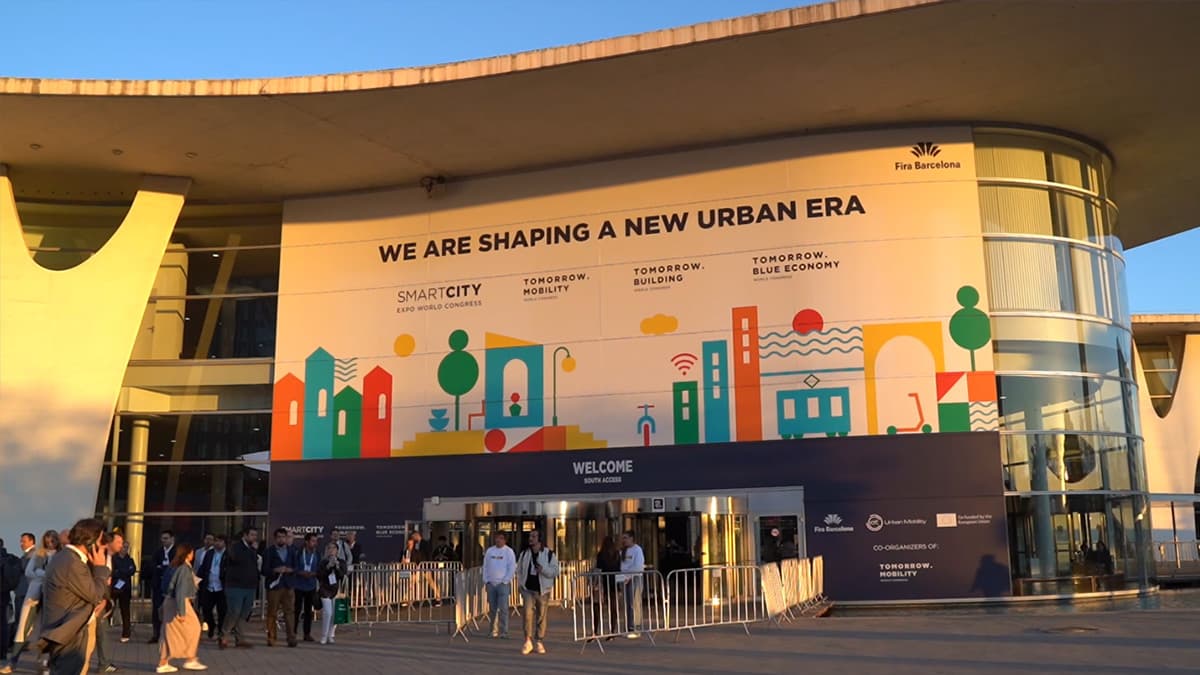
Smart City Expo World Congress Barcelona 2024
Bridging Public and Private: Takehiko Nagumo on Japan's Evolving Smart Cities
📖 Read Video Transcript
We have been, facing a big wave of smart cities in Japan.
And it should be supported not only by the public sector or only by private sector.
So we needed something in the middle.
So we created a not for profit organization actually driven by private sector but having public institutions as members.
So our vision include, 370 municipalities as members, seven national ministries as a member.
Several country embassies in Tokyo as members.
And in addition to corporations, universities and so forth.
We are moving towards a more mature smart city.
We were obsessed with the technology fantasies, so to speak, for the past decade or so.
Everyone loves the technologies.
But after actually implementing technologies, we felt like we got lost in translation.
What's the purpose of implementing technologies?
It wasn't clear.
So we went back to the basics.
Human centered ideas.
So we started to implement the well-being city indicators as a starting point to set objectives for implementing smart cities.
In Japan, traditionally, and even today, there are two big domains, so to speak, very popular amongst the smart city practitioners.
One is mobility.
Japan is a mobility country.
Cars, trains...
So that's number one.
Second is the health.
Currently, most of the smart city projects in Japan are funded by, actually subsidized by the digital agencies, other relevant ministries of Japan.
So it's public funds.
And partially, these services are funded by the private companies.
So it's monetized as well by private companies, but mostly so far public funds.
To me, the most successful case in Japan would be Maebashi city, and Aizuwakamatsu city.
Two cities.
And they are implementing in a good collaboration with the corporations.
Actually led by the city council, but, collaborating with the corporations at the local level and national level.
They are doing very well, particularly, Maebashi City.
They create their own digital ID.
Before, the national ID, this idea was fully implemented.
So it's beyond the national digital ID, which can also, link the basic public service plus private services.
So I think it's, cutting edge and also the depth of the implementation.
Aizuwakamatsu city, It's a hard to pronounce.
Aizuwakamatsu city is the other one.
It was a smart city implemented after Great Eastern earthquake to place as a recovery policy.
So everything is devastated.
But for how do you want to recover from the devastated situation?
Accenture, American Consulting Company, came in to recover.
And they introduced the concept of the smart city, which turned out to be spearheading case studies in Japan.
US, it's more capitalistic, so to speak.
I lived in the US for 12 years, so I am a big fan of America.
But, I think we are a little bit apart from the US model right now and more similar to the European style, which is more collaborative between companies and the local governments or civic society.
So in terms of the model, I think we are sitting somewhere closer to Europe.
And we are further emphasizing again, well-being of citizens as a centerpiece of smart city development, which is a little similar to Nordic countries.
Right?
So Nordic countries has a well-being model and innovation.
Netherlands, maybe another model I know for a digital government then there's UK.
So it's a hybrid of those.
More Smart City Expo World Congress Barcelona editions



Recent event coverage
See all


Latest Kurrant Originals
See all

Latest news
All news- eThekwini Municipality Plans Citywide Smart Water Meter Rollout Against 58% Non-Revenue Water2 Nov 2026
- The Australian Renewable Energy Agency Funds A$4.1M JET Charge V2G Trial2 Nov 2026
- TALQ Consortium Releases Edition 5 Tender Template For Interoperable Smart Street Lighting31 Oct 2026
- City Of Zadar Selects ELIPSA For €197,900 Design Of Intelligent Transport System Phase Two31 Oct 2026
Kurrant advisory
Planning a smart city or utility project? Talk to Kurrant.
Behind these interviews is Kurrant's advisory team, working with utilities, cities and the companies that serve them.
- Strategy AdvisoryKurrant is actively involved in resolving the challenges that cities, utilities and industry players are facing.
- M&A AdvisorySmart city and utility expertise for successful deals, turning insights into strategic gains.
- Engineering & ProcurementBetter engineering and procurement decisions, by identifying and developing digital and IoT solutions across use cases.
Or write to us: contact@kurrant.com
Send us a message
© Kurrant. All Rights Reserved. · Editorial Standards · Cookie settings
This site is protected by reCAPTCHA and the Google Privacy Policy and Terms of Service apply.