Meet  in Barcelona
 3 to 5 Nov 2026
Pavilion 3 · Booth D151
Our scheduleSchedule
Live from Barcelona · 1 videoLive
Book a meeting
in Barcelona
3 to 5 Nov 2026
Pavilion 3 · Booth D151
Our scheduleSchedule
Live from Barcelona · 1 videoLive
Book a meeting
← Back to all events
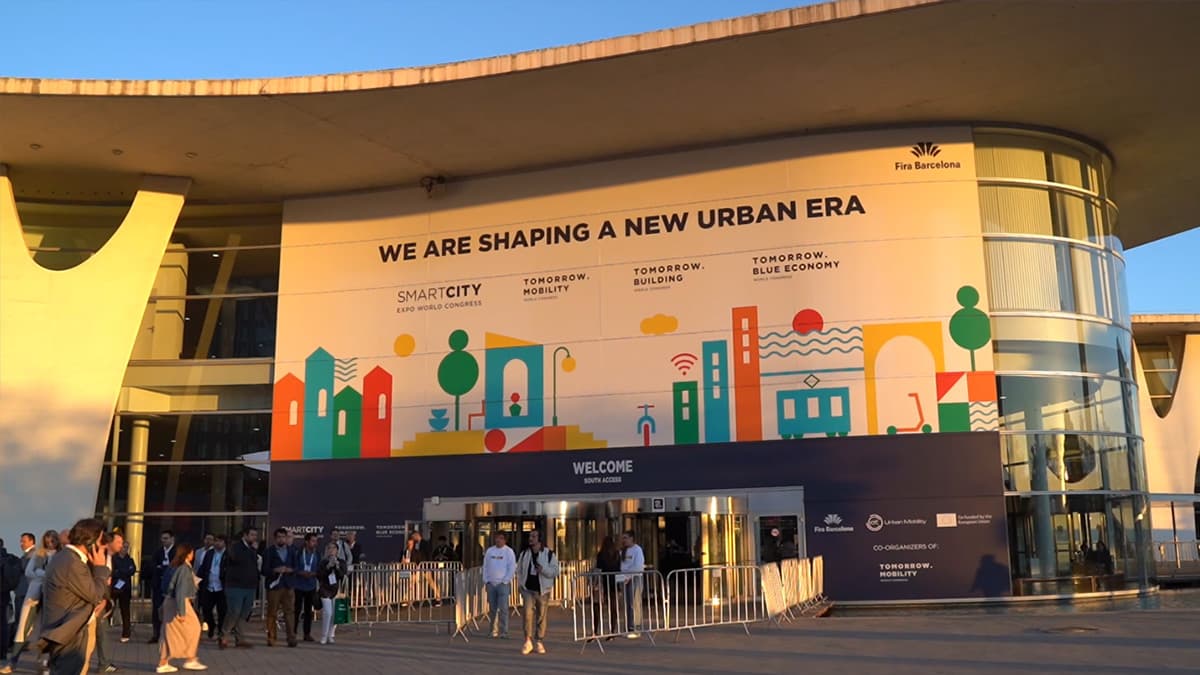
Smart City Expo World Congress Barcelona 2024
Transforming Cities: Jeff Merritt on the World Economic Forum's Role in Urban and Smart City Innovation
📖 Read Video Transcript
I'm here with Jeff Merritt.
He is Head of Urban Transformation at the World Economic Forum.
Jeff you’re from the World Economic Forum.
So can you tell me a bit about their role in urban transformation?
Absolutely.
So the World Economic Forum's been around for over 50 years.
Founded in 1971 and most people know the organization from a meeting we have in a town called Davos in Switzerland that happens every January.
A lot of folks don't know that, actually, the organization is working year round.
It's the international organization for public private collaboration.
That means that when you have tough global challenges, which let's be honest, we have a lot of those nowadays, these are challenges that neither the public sector, the private sector are going to be able to accomplish or address on their own.
We need to actually drive that collective action, and that's what we do.
And, you know, it's fair to say for any global challenge, you can only go so far when you're talking about something in that macro level.
What my team does is look at how do we translate that global ambition.
Let's say we're talking about something like driving action on climate change.
You can reach a big global agreement on reducing greenhouse gases in a particular sector, but you actually have to focus at the local level.
And how does that actually play out?
What are the regulations required, what is the role of government?
What is the role of the private sector?
And so what my team does, it's a team of practitioners working around the world to really show how to get things done when you're focused on driving global action, but at a local scale.
What are the trends you're seeing right now?
The global trends you're seeing right now regarding smart cities, and which do you think we will see in the future?
Sustainability, climate action, types of solutions.
We're seeing a dramatic rise in those as we should.
That state of the world.
I mean, we're here in Barcelona and just last week, they had horrific tragedies in Valencia, hundreds dying there because of flash floods due to extreme weather.
This is the new global norm.
You can't say anymore it's a once in a century thing when we're seeing that every month in some part of the world, these types of extreme weather events and various impacts of climate change are daily life in cities.
I think we're seeing, a positive evolution in, smart city solutions.
One if we go back ten years ago and looked at those solutions, they were pretty much 100% digital technologies.
What I mean by that is a lot of like internet of things sensing devices that would give you situational awareness.
So if we use what I was just talking about, about extreme weather and flooding, a sensor will let you know how much water you have where at different points of time, and therefore you are able to act more efficiently to respond.
Great.
What we're seeing now is a lot of layers built upon that.
So you might be looking at how you can have the sensors, that you can build a digital twin on that, and then use AI to run predictive analytics to help predict how you might respond in the next storm event in advance.
But then also we're seeing nature based solutions, really, for the first time, I think kind of being able to put next door or in, you know, in conjunction with these digital technologies, I think that is an incredibly exciting development because the best solutions are not the newest solutions.
And the more in which we can think about the integration of different approaches, that how does design integrate in, good design and good city planning, integration with technology.
If you have a holistic approach on how a suite of different solutions can come together, that's where you can actually drive the impact.
Where are we right now?
Do you see projects succeed and cities scaling these projects?
And the ones that fail, what did they do wrong?
There is not a sort of single state of play here globally.
You're going to find some cities around the world that are repeating the mistakes of 20 years ago, where you have companies that are coming in trying to sell a bright, shiny object, and they've got an incredible PowerPoint presentation and they're like, you need to buy this solution.
It will save the world.
And they are buying solutions.
And then ultimately realizing that they can't actually deploy that solution, integrate it.
They're not thinking about the behavior change and the maintenance and continued investment in it.
And in a few years, that solution will be thrown in the garbage and they'll go back to their old ways.
But then you also have folks that I think are thinking about ways in which maybe actually in that particular case, maybe if you think creatively about the business model, government doesn't need to actually buy that solution, deploy that solution.
They simply have to give right away access or enable an opportunity where the business community can operate in their city and have a much more sort of sustainable business model that makes life better for residents.
It provides more city services and ultimately provides the profits that their shareholders expect.
Let's talk about AI.
The buzzword.
This summer we saw that the EU launched the AI Act.
We don't see something like this in the US, but how do you see this affecting or impacting the smart city industry?
Artificial intelligence is simply an iteration on machine learning, where you're leveraging data to provide insights and take actions automated in many cases.
So there are decades of regulations that exist on data that you build up on.
So anybody that comes in and says, here's this magic, piece of legislation for AI, I think is not actually fully understanding that AI is an evolution of a lot of technologies and built on a lot of preexisting governance models.
And that's actually where you get into trouble is if you're not actually thinking in that sort of incremental way, ideally, you're putting in good data management practices, cybersecurity practices that might need to be iterated on slightly based upon a sort of evolution of AI technology, advancement of AI, for example.
But if you go in and put in a whole nother piece of legislation that actually can create more problems than good, because then you're creating this sort of confusion where companies well, I thought that we were following this particular sort of protocol here.
And how do I make sense of these sort of two.
So I think, you know, it's important that we realize that governance is something that needs to be based on a set of core sort of principles and values.
And that then we look to see how do we build on existing governance, strengthen them as we have new technologies.
And so amending and iterating upon the past is usually going to be a better approach than just throwing in another, you know, buzzword piece of legislation.
More Smart City Expo World Congress Barcelona editions



Recent event coverage
See all


Latest Kurrant Originals
See all

Latest news
All news- eThekwini Municipality Plans Citywide Smart Water Meter Rollout Against 58% Non-Revenue Water2 Nov 2026
- The Australian Renewable Energy Agency Funds A$4.1M JET Charge V2G Trial2 Nov 2026
- TALQ Consortium Releases Edition 5 Tender Template For Interoperable Smart Street Lighting31 Oct 2026
- City Of Zadar Selects ELIPSA For €197,900 Design Of Intelligent Transport System Phase Two31 Oct 2026
Kurrant advisory
Planning a smart city or utility project? Talk to Kurrant.
Behind these interviews is Kurrant's advisory team, working with utilities, cities and the companies that serve them.
- Strategy AdvisoryKurrant is actively involved in resolving the challenges that cities, utilities and industry players are facing.
- M&A AdvisorySmart city and utility expertise for successful deals, turning insights into strategic gains.
- Engineering & ProcurementBetter engineering and procurement decisions, by identifying and developing digital and IoT solutions across use cases.
Or write to us: contact@kurrant.com
Send us a message
© Kurrant. All Rights Reserved. · Editorial Standards · Cookie settings
This site is protected by reCAPTCHA and the Google Privacy Policy and Terms of Service apply.