 in Barcelona
 3 to 5 Nov 2026
Smart City Expo World Congress Barcelona 2026
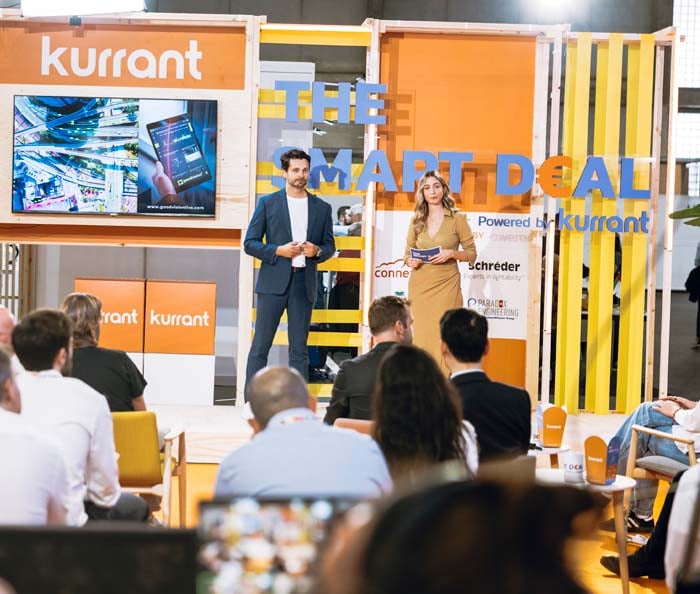
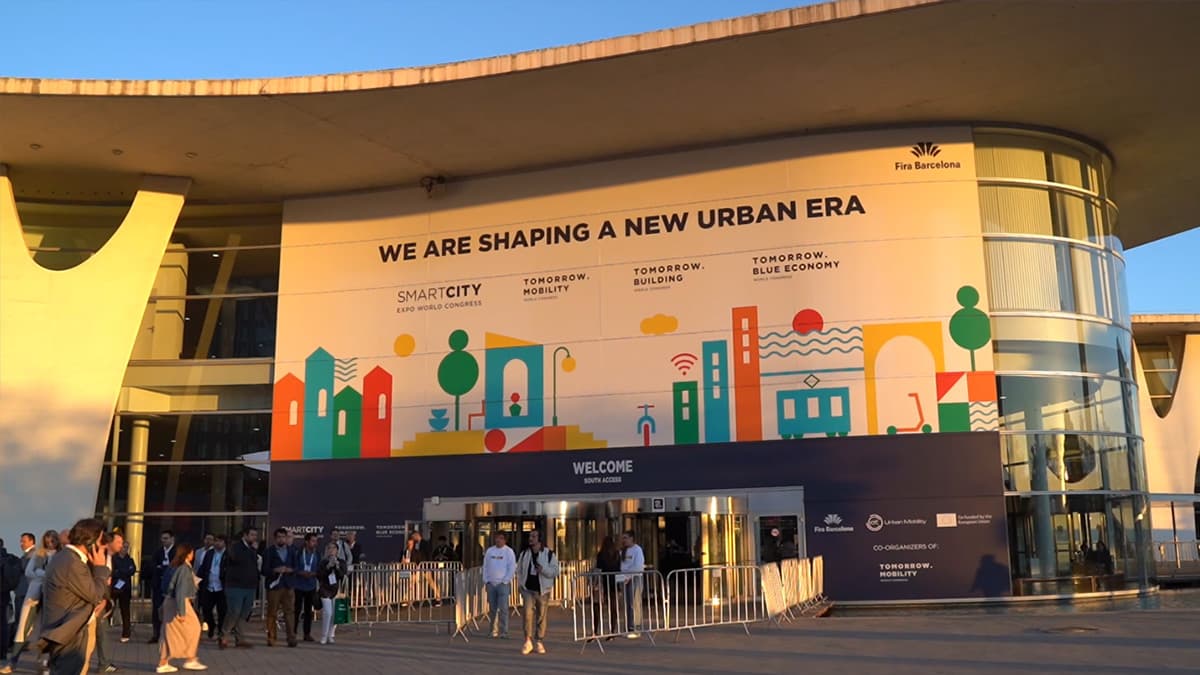
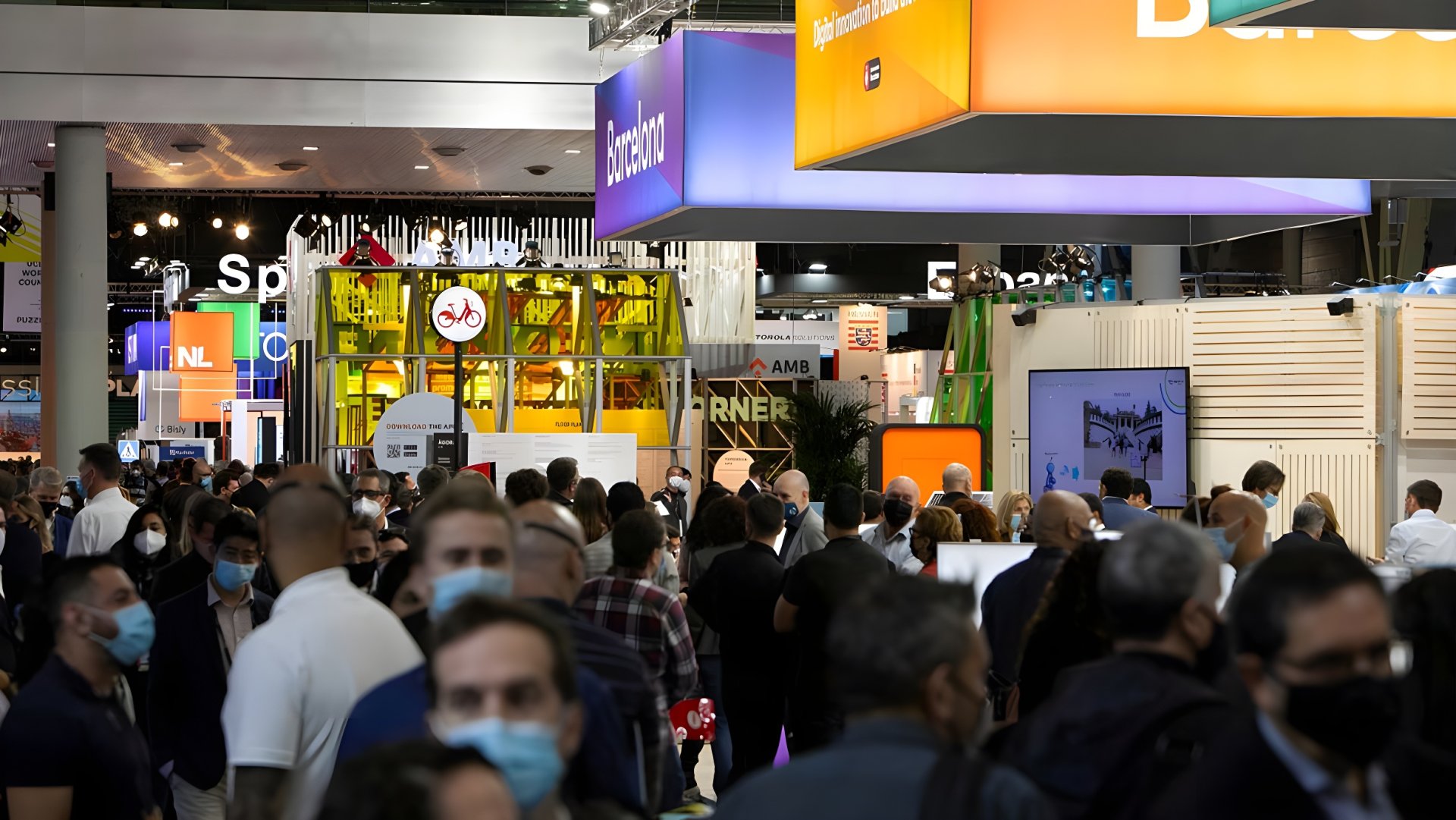
Smart City Expo World Congress 2026, Barcelona, 3 to 5 November. Kurrant films the expo floor, interviews with city and utility leaders and the companies that work with them, and The Smart Deal live pitches at Booth D151 in Pavilion 3. Videos are added here as we film them.
Stadium Cities: testing grounds for mobility
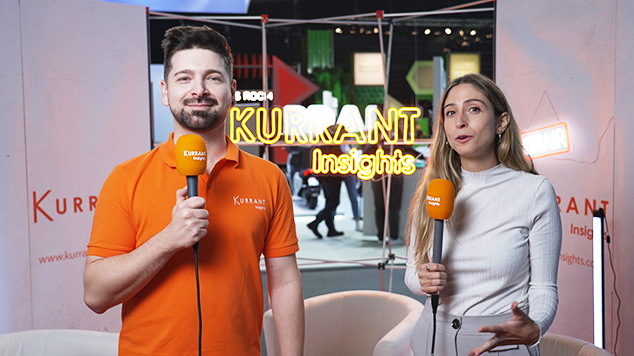
Can a stadium district become a testing ground for the city around it? On the Kurrant booth, Emma Lozano Doogan of Kurrant speaks with Hellas Verdurmen, Project Manager at APPM Management Consultants, and Ydze Rijff, Head of Mobility and Environment at Johan Cruijff ArenA, about Stadium Cities. The network turns stadium districts into test sites for urban mobility and shares what works between cities. They talk about Amsterdam’s fast-growing arena district, the lesson learned from Wembley and a smart shared calendar for events, construction and road works.
Recorded on the Kurrant booth at Smart City Expo World Congress 2026, Barcelona.
📖 Read Video Transcript
the Kurrant booth at the
Smart City Expo World
Congress here in Barcelona.
I am on the booth, on our
stage, with Hellas Verdurmen,
Project Manager at APPM
Management Consultants.
Happy to be here.
Welcome.
And Ydze Rijff, Head of Mobility and
Environment at Johan Cruijff ArenA.
Happy to be here too.
Welcome.
We're going to be discussing
the initiative Stadium Cities,
which turns stadium districts into
testing grounds for urban
mobility innovation.
with the goal of developing solutions
that can be replicated across cities.
So the first question is for Hellas.
Amsterdam and the Johan
Cruijff Arena have been at the
heart of the Stadium Cities
movement from the beginning.
Where did the idea for Stadium Cities
come from, and what challenge or
opportunity were you trying to
address when the initiative launched?
Well, to begin with, in
this area of the city,
there's a huge development going on.
There's going to be
44,000 homes added,
30,000 extra jobs created.
And we do have a lot of
venues at the moment,
Johan Cruijff Arena, the
Ziggo Dome, and the AFAS Live.
And there's also some more
leisure functions being added.
Extra theater, extra little
stadium, extra pop podium.
So it's gonna increase the
amount of people living there,
the amount of people working there,
and the amount of people
that are visiting the area.
And every single time there
is an event in the area,
it's always a lot of work to
get people in and out safe,
make sure that they
have a nice experience,
come earlier, leave later, and spend.
That's what we always say.
And therefore, it's important to
work together in combining all these
things and make sure that people
can do that today, tomorrow when
the city is expanding and being a
building ground, and tomorrow when
the city is ready and we do have
a lot of extra people in the area.
And therefore, we
thought we have to do
something to today,
tomorrow, and the day after.
Ydze, there are many urban networks
focused on mobility, sustainability,
innovation, or economic development,
but why is it important to have a
network dedicated specifically to
stadium districts and stadium cities?
So that's a good question.
I think what's good to realize
and what we know is that a stadium
in fact is a micro version of
the city it stands in because it
brings together 50,000 or more
people that eat, that need energy,
that go to the toilet, that meet
each other, that move in and out.
We're already using our stadium as a
living lab, the
building, for 30 years.
We're the first stadium that
has become a B Corp in the
world because we have a fully
sustainable energy system
with 2 batteries that we
charge with our solar panels.
And we've also done that
with our partners by offering
our stadium as a living
lab to the ecosystem.
And now that this is happening
with the city, mobility and all the
movement of people through the area
is the next challenge we're facing.
Because for many years in
Europe, but also throughout
the world, stadiums have
been moving outside of the
city because there was
space to build.
And nowadays we're starting to realize
we can't do that over and over again.
So we're mixing in stadiums
and urban developments.
And this is for us a really urgent
topic to keep our license to operate
because we need the environment to
get all these people in and out.
And we are confident that the
stadium idea of using the stadium
as a living lab can also be
applied to the district and can
be a way to innovate together
with your partners. And that same
analogy of a small city also
enables the stadium to be an
instrument to exchange knowledge
between cities, because it brings
all the complexity of a city
into a really small environment.
And it's really easy to exchange
knowledge and share ideas and
scale between stadiums and then
from the stadium out to the city.
And actually, that was the case
when we started this initiative,
that we felt like this small
city and the development
and the customer experience,
everything is important.
But we cannot be the only ones
having the same challenges.
It must be everywhere.
So we started reaching out to
other cities, other stadiums,
asking the question, do you have the
same mobility questions as we have?
And actually, that was the case.
So then we started.
And then when it comes to
the city, what value does
it bring to that city to
be part of the network?
Well, because we do have the
same challenges everywhere.
Amsterdam is huge in terms of tourism.
We do get a lot of locals going.
We do get a lot of regional
people and national people,
international people
coming to the area.
So in all the mobility
questions that we have,
in the customer experience
questions that we have,
it's very useful to use this kind
of area as a small city to try
to develop solutions, proven
solutions, new solutions.
That's all we are looking
for, and therefore
that's the value for the city as well.
And maybe if I may add on to that,
I think also the value for
the city or for the district
well, in a whole, is that
currently there is no
place or platform where
these 2 worlds collaborate.
And here at Smart City Expo, we
find the whole city ecosystem.
But not many people here talk
about stadiums and events.
It's mostly about the city.
And on the other hand, we have
the stadium network and they're
all talking about fan experience
and crowd management within
the stadium and technical
solutions, safety, you name it.
But we're not talking to
each other while these
developments are happening
all over the world.
Creating a platform and a
network where these people
can actually meet each other
and these ecosystems can
work together, there is
so much low-hanging fruit,
quick wins, because all these
challenges are very similar.
And even with the movement
we just started a year ago,
really simple conversations, just
visiting each other already helped us
in such big steps to improve the
way you approach this problem.
And then it's that
traditionally stadiums were seen
as places people visited
for a match or a concert.
What does it mean today to think
of a stadium district as part
of the city's urban ecosystem?
So our stadium is owned
partly by the city.
And they said, we want you to
become a sustainability icon.
So to really be an anchor of
urban development, be an anchor
of positive change, societal
impact, and of sustainability.
So that also has driven us,
or they have asked us to
do this. And then that has, well,
completely become part of our DNA,
which has led to, you know,
eventually us becoming a B Corp.
But what we found as
well, if we are good for
our environment, we're
good for ourselves.
And that's something that
we, on top of the economic
function, economic
value, and the value of,
you know, hosting events
and connecting people,
it's also very much about,
okay, how can we play
a role in the energy
systems with the batteries?
We're charging our events, but
we're also balancing the energy
grid of the community around us
because there's a lot of grid
congestion and issues on the
energy grid in the Netherlands.
So that's also a role we're playing.
Being a clubhouse, sort of a
gathering place for all the local
residents that live in the
neighborhood, host neighborhood days,
facilitate sort of matchmaking for
jobs and all sorts of activities,
is much more value you can
bring to a city and the
surrounding neighborhood than
just hosting an event every week.
You can bring value every day.
Okay, and then my next
question is for both.
So Amsterdam is an example of how the
stadium and the city
can work together.
What is one lesson from
your partnership that
other cities in the
Stadium Cities Network
could realistically apply
in their own context?
Hellas, if you want to start.
Well, actually, I would
say that also initiatives
like this needs strong
shoulders to begin with.
I think that the co-working
parties in the area together,
and especially Johan Cruijff
Arena and the city of Amsterdam,
you need people who go for
it and who start doing it
and then sort of learn and
see what you can gain from it.
But you need forerunners to do so.
And by doing it, we get
a lot of extra partners
with us who feel exactly the same way.
So that's good.
And there's one lesson that mostly
resonates with me, and I have to give
credit to Wembley Stadium for this
because we learned it from them.
They're at the moment the,
well, I think the very
best practice of how to
integrate a really high-density
urban housing development
with a big venue.
And what they teach us
and what we now can also
help teaching others is that
it starts with a vision,
with a dream, with a narrative of the
local stakeholders that
are working together.
And that starts with getting
all the relevant stakeholders
around the table, all the
blood groups, you could say,
and just say, okay, what kind
of area do we want to become?
And then what can everybody
do to contribute to that goal?
The actions, the contributions,
the agreements, the documents,
the contracts, it will be
different in every city.
But you can, by convening around the
stadium as sort of the modern church,
you could almost say it, you
can gather this coalition
together and really build your
own narrative and your own dream.
And that's where it starts.
The local coalition
will know what to do.
Okay, and what is some smart
city, smart mobility tech that is
being tested at the moment or
that you're going to be testing?
The Arena portal what we built,
because this was also one of
the interventions that we,
you know, found out together
that we said we need,
we really need this
to achieve our goals.
And that's, in our case, it's large
events happening simultaneously with
the several venues, so sometimes
several at a time, large construction
activities for all the urban
developments, and road and rail works.
And how do we plan and evaluate
on preparing if they collide?
And so we built a smart calendar
where we all share data on a
platform that's protected and,
well, hosted in the Netherlands.
And with a company
called Klepform,
and they're really helping
us to build this product.
To have a shared calendar,
it's really that simple.
But a calendar that is smart
and actually can use all
the data to help us predict
and evaluate interventions.
And also, you know, in the age
of machine learning and AI,
we can learn a lot from that data.
And actually, we feel that
simple developments like this or
innovations or other experiences
which are scalable to other
parties in other cities, that
will be really helpful for them
sharing it with us and for us
sharing it with the others.
as the Stadium Cities
network continues to grow,
what do you hope it will
achieve over the next 5 years?
And I'd like to get an answer
from both of you on that one.
Well, I would hope that in a few
coming years, it's going fast at
the moment, that we do have a large
collaboration working together,
sharing knowledge and experience,
getting new technologies,
initiatives, proven technologies
and innovations to our area.
And basically to get people safe
in and out and have a very nice
livable area for the residents
and the working people as well.
Yeah, completely, completely agree.
I think in 5 years I would hope
that we would have, you know,
an annual moment where this
whole network comes together
and that we just have a
couple of examples of proven
tangible projects that were, you
know, brought to the market by
a shared demand of several
stadiums that actually needed
the same solution and that we
used that scale to bring it
to the market and also scale
it to several stadium cities.
and that we can prove that it works.
Okay, well, thank you very
much for these answers.
And I think the next step is me coming
to Amsterdam to check out the project.
Always welcome.
Concerts or football, we have all.
Great.
Thank you for having us.
About Smart City Expo World Congress Barcelona 2026
Smart City Expo World Congress 2026, Barcelona, 3 to 5 November. Kurrant films the expo floor, interviews with city and utility leaders and the companies that work with them, and The Smart Deal live pitches at Booth D151 in Pavilion 3. Videos are added here as we film them.
More Smart City Expo World Congress Barcelona editions
Latest Kurrantly News
All news Australian Energy Regulator Lets Essential Energy Own 300 Streetlight EV Chargers In Regional NSW
 Autobahn GmbH Tenders 3,120 E-Truck Charge Points At 227 Serviced Motorway Rest Areas
 Columbia, Missouri To Start Smart Meter Installs In Spring 2027, Funded By Special Obligation Bonds
 EDF Agrees To Buy Utilita Owner Luxion, Adding 1.3 Million UK Energy Accounts
 Natal Starts Installing Adaptive Traffic Signals On Avenida Prudente De Morais
 BrightAI Raises $97M At Reported $750M Valuation, With GE Vernova As Investor
Latest Kurrant Originals
See all
Kurrant advisory
Planning a smart city or utility project? Talk to Kurrant.
Behind these interviews is Kurrant's advisory team, working with utilities, cities and the companies that serve them.
- Strategy AdvisoryKurrant is actively involved in resolving the challenges that cities, utilities and industry players are facing.
- M&A AdvisorySmart city and utility expertise for successful deals, turning insights into strategic gains.
- Engineering & ProcurementBetter engineering and procurement decisions, by identifying and developing digital and IoT solutions across use cases.
Or write to us: contact@kurrant.com
Send us a message
© Kurrant. All Rights Reserved. · Editorial Standards · Cookie settings
This site is protected by reCAPTCHA and the Google Privacy Policy and Terms of Service apply.